Last updated on May 23rd, 2020 at 03:36 pm
This summer I had the privilege of designing and teaching a course that involved creating ePortfolios. I drew upon a lot of my prior experience and knowledge about open education and online learning to design the course. From a learning theory perspective, connectivism and heutagogy were great influences.
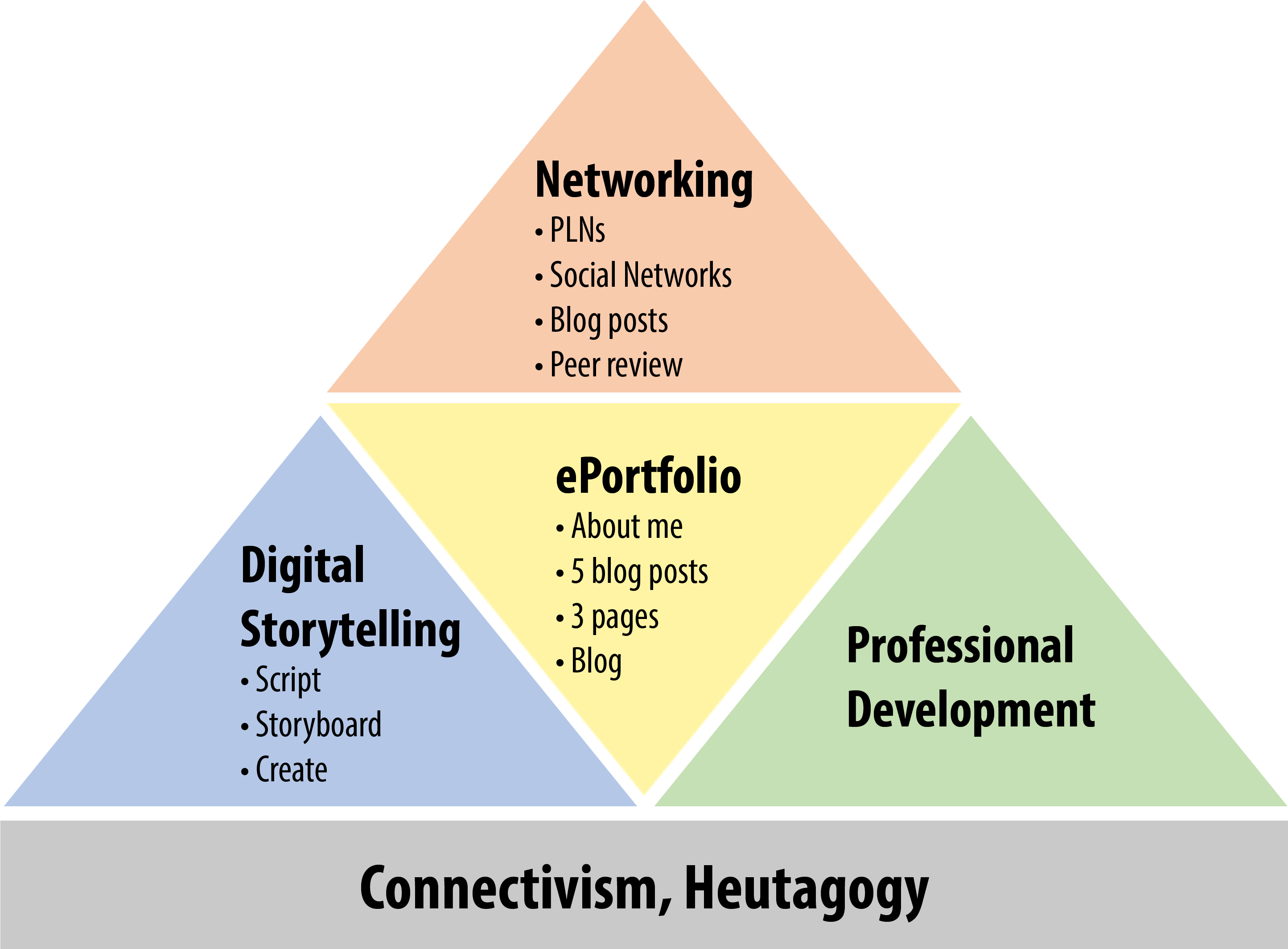
When designing courses, I like to be able to create a structure for the course that can be visualized. In this case, I created the visualization that I shared as the feature image for this post.
ePortfolio
The ePortfolio component is intentionally in the middle, as the intent is that the networking, digital storytelling, and professional development all created things that helped with the development of an ePortfolio.
Networking
I began the course with a reading about networking as an act of generocity – Shenoy, S. (2019, march 15). Why generocity is the key to effective networking. The Dream Catcher: Live your dream live: Make a difference. Retrieved from http://thedreamcatch.com/generosity-is-the-key-to-effective-networking/.
I really like this post, as it put networking into a different perspective for a lot of my students. I had not thought about how I did a lot of this generocity naturally, so it had not occurred to me the need to make it intentional. The article helped to highlight that networking isn’t just about projecting your talents, but rather it is more about using your talents to help other people. This also aligns nicely with the Mozilla Web Literacy framework idea of participation. Students generally understand the reading part of web literacy, and the writing part – but the participation part can be a little more challenging.
My students are generous with each other – they offer to help each other and they provide awesome feedback during peer review cycles. They encourage each other. I’m not sure yet how well they are practicing generocity beyond the scope of their own blogs – but it is a starting place.
This is one area of the course that needs more intentional work. My students didn’t find this aspect as useful as the other parts of the course – and that in part might just be that I didn’t highlight well enough what activities actually led to good networking practices.
Digital storytelling
I love digital storytelling. I love the idea of 2-3 minute YouTube videos as a way to communicate something. I wanted students to create short digital stories about themselves because it is a memorable way to introduce yourself and your ePortfolio. I also figured that as instructional designers, the skills associated with being able to draft and produce a digital story are important. For many of my students, it was their first opportunity to create a cohesive story-based video. It involved script writing, storyboarding, audio recording and video editing.
I asked students to create two stories. One could be on any topic, but the other had to be something that introduced who their were as instructional designers. I gave an example of my story – which I now need to go and update, as one of my students taught me about the Ken Burns effect on video, and I definitely need to incorporate it to make my video more interesting to watch.
As a warm-up activity, I had student spend no more than an hour (that was the rule) creating a quick story on any top using Adobe Spark. That worked out really well, as it helped those who where timid about video editing technology to get over a few of the initial hurdles. I think I’m going to try to incorporate Adobe Spark into a couple of my other classes.
Professional development
Since my students all came into the class with differing levels of experience, I gave them the opportunity to spend some of their class time on a professional development project of their choice. They had to submit a proposal early in the course, and at the end they had to create an asset for their ePortfolio and write a short report. Next time I teach the course, I think I will change it to be either an asset or a report. As much as I enjoyed reading the reports, I think that it was just an extra bit of work that the students didn’t need – especially if they were blogging.
ePortfolio
Now back to the ePortfolio. Here I began with a project that was heavily influenced by Domain of One’s Own. I had students purchase their own domain (there wasn’t a textbook for the course, but there was a requirement to purchase a domain). I suggested Reclaim Hosting for this because of their excellent customer support (which a couple of my students ended up using). I required students to install WordPress and create their portfolio and blog on WordPress. Their portfolio needed at least 3 pages – largely because I wanted to see that they had learned how to create pages and associated menus.
After a short presentation on how to write good blog posts, I had students write at least 5 posts throughout the course. Each week I gave them ideas as to what they could write about, but didn’t require any specific content. I did require that they write at least one blog post that linked to someone else’s blog – and that someone should be someone who is not in the course. They also were required to comment on blogs – their classmates blogs and I tried to encourage them to leave a comment on someone else’s blog – again helping them expand their networks. The quality of their blog posts amazed me. I think every single one of them would make great bloggers!
Conclusions
So far, I’ve received a lot of positive feedback for the course. Many of the students went into the course with no knowledge of WordPress, and specifically no knowledge of self-hosted websites. Also, many of the students had little or no knowledge of video editing software. They came out of the class with so much more confidence.
One thing that I found I liked about the framework was that the different triangles used different parts of the brain – so when students were getting burned out with technical stuff, they could shift their work to doing creative stuff. That allowed them to work on different aspects of the course based upon what was personally effective for them. I often gave them advice that they were not “behind” if they were ahead in one area – so they could work on one thing while they were being productive, and when their time on that stopped being productive, they could shift to another area.
Overall, this has been a great experience for me. I am looking forward to teaching the course again. As always, my students surprised me with just how well their stories, blog posts, and ePortfolios turned out.
Have you taught an ePortfolio / online presence course? What types of activities did you find most effective?

Leave a Reply