Category: Healthcare

  • Navigating the Healthcare System

    Navigating the Healthcare System

    This post is a continuation on my discussion about Patient Health Literacy. The narrative that resulted from this study has been published on Amazon. See my Memoir page. The original source that I used for my study can be found at https://bcbecky.com.

    In reviewing the posts categorized as Navigating the healthcare system, I constructed the following themes: (1) learning processes, (2) taking control, (3) dealing with insurance, and (4) waiting. The theme learning processes applies to posts where I describe the different interactions I’m having with healthcare providers. The theme taking control applies to posts where I voice my need to empower myself or others by exerting some form of control over a situation. The theme dealing with insurance applies to posts where I write about issues insurance coverage of medication and treatments. The theme waiting applies to posts where I write about issues with waiting for various test results or treatments. I discuss each of these themes in more detail in the in the following sections.

    Learning Processes

    In the beginning I had no understanding of how the medical system worked with respect to cancer treatment. My understanding came only from what I saw on television and from an acquaintance that I sailed with 15 years ago who happened to be a medical oncologist. From that, I knew that there were different types of oncologist, but I did not understand that breast cancer treatment typically begins with surgery. Throughout the blog, I explore and share my interactions with the medical system, as I learn to negotiate it.

    In Canada, I likely would not have had much choice in where I received treatment. I also would not have thought that a I had any choice in surgeon or oncologist. I would go to who I was referred to. In the US, and specifically in the area where I live, there are multiple providers. In some ways insurance affects where you get treatment, but I had really good insurance that allowed me the option of choosing. After hearing the words ‘you have cancer’ I felt an immediate sense of lack of control. The ability to choose a healthcare provider, although stressful and a completely new process for me, was also a way to exert some control over the situation.

    As all the processes were new to me, I explained them in detail as they occurred. For example, in A long day (June 19, 2014), I explain the process of the appointment with the surgeon as well as the “whirs, honks, and other sounds” associated with my first experience with magnetic resonance imaging (MRI). I continue with the description of processes on my first day of chemotherapy, where I also include images that provide visual documentation of the process (First day of chemo, July 7, 2014). Further, in This too shall pass (July 16, 2014), I describe how:

    They don’t give you much other than anti-nausea meds for the first cycle, and they wait for you to call. The idea is that everyone experiences chemo differently, so they don’t know what you will need. They wait until they find out what you need then prescribe it. At this point, it is all about managing the symptoms. Unless the problem is life threatening (more life threatening than the cancer), the goal is to keep with the chemo regime on schedule through to the end.
    Images fromFirst day of chemo, July 7, 2014

    In addition to describing the medical process, I also described what I learned about the process of gathering information from my care team. In I had to give myself permission to nap (July 9, 2014), I outline what I learned about how nurses and physicians provide different levels of information:

    Nurses tend to provide advice on the extreme side of things. For example, absolutely no alcohol, no swimming, no biking. They tend to provide advice based upon the worst-case scenario, but also discount mental health. The need to exercise is important to my mental health. The oncologist is good – he explains the chemo cycle – and says it is OK to swim the first week, but as my white blood counts get low to stop swimming until the counts return.

    My analysis also shows that, in addition to describing the processes as I recalled them, I also wrote about my observations regarding medical education from the interpersonal perspective:

    What has been interesting is that this seems to be part of the learning process. Those who are most empathetic are the attending surgeons. The residents are still learning, so their interactions can feel a little mechanical – they are still trying to figure out the best ways to make connections with patients, but also the best ways to describe things. By the time they are fellows, you see a higher level of confidence in their ability to provide patient education – and you start to see information that is more customization to your specific case. The attending surgeons seem to be the best at tailoring their discussions to your specific situation.

    Finally, when I was hospitalized after surgery, I described my experience with hospital processes, specifically how a private room meant that my husband could stay the night with me, and the quality and process of getting food: “One thing that impressed me about the university hospital is that they use a room service model for food. The menu is quite good, and so far, the food has been good. The food is locally sourced where possible, and there are organic options” (An update from the hospital, November 20, 2014).

    Taking Control

    From the beginning I tried to take control by booking appointments for a second opinion from the university healthcare system. Here I was immediately frustrated at an inability to get an appointment without a confirmed pathology. Fortunately, they did guarantee me an appointment when the pathology results were confirmed (The speed of things, June 15, 2014). After getting an appointment, the act itself of seeking a second opinion and making a choice as to where to get healthcare were ways that I could take control (Double-mastectomy and chemo, June 19, 2014).

    When I began to experience some odd side effects, specifically blisters on my hands, that were not resolving, we made the decision to go to the emergency room. This was in part so that we could experience the process of the emergency room at a time when we were not overly stressed – that is, “while I was happily ambulatory and not ‘really sick’, just in case I needed the services at a later time” (Not without incident, July 13, 2014). Further, in Engaged patient in a hospital gown? (September 27, 2014), I describe the process of a typical doctors’ appointment – and how I take as much control as I can during those appointments, in this case by wearing a hoody over the hospital gown.

    Dealing with Insurance

    The role of insurance in the treatment for breast cancer both surprised and outraged me. I was surprised when one of the first things the surgeon told me, after telling me he recommended a double mastectomy, was the ‘good news’ that insurance was required to pay for reconstruction (How do you prepare to lose a body part?, June 15, 2014). I was surprised when the oncologist mentioned that “it also takes about a week to get approvals from the insurance company” (Caution – this one talks a bit about death, June 21, 2014) before I could start chemotherapy.

    We ran into issues with insurance and treatment after my first day of chemotherapy, which required the white blood cell booster Neulasta to be administered the following day. Insurance changed the way in which it was to be delivered (Pains with the American System, July 7, 2014). Finally, with a slightly more nuanced understanding of the way insurance impacts healthcare in the United States, I write a response to a New York Times article expressing my concern “that research stated like this gives insurance companies a reason not to pay for the surgery, when it may be in the best interest of the individual” (Bilateral mastectomies, July 28, 2014).

    Waiting

    Waiting was something that I ran into from the very beginning. First it was waiting for the pathology results, as I could not make an appointment at the university cancer center without confirmed pathology (The speed of things, June 16, 2013). When we were deciding on where to get treatment, we knew that we would be spending more time waiting at the university cancer center. We took waiting into consideration when making our decision, specifically I write:

    In the first couple weeks after diagnosis, I had decided where I was going to get treatment. I based this, in part, on where I felt comfortable – but also who provided me with the most options. I really liked being in a teaching setting and having access to more specialists – but that was balanced with knowing that I would spend more time in waiting rooms and receive less fancy care (e.g. the infusion treatment center doesn’t provide lunch).

    As I went through treatment, there were many occasions where I describe what I felt to be excessive wait times. For example, “It turned into a long day. We had a delay seeing the nurse practitioner to get sign off on chemo – unfortunately that turned into a three-hour delay. Then we had a delay on the saline drip for rehydration, which added another additional hour” (AC Cycle 4, August 19, 2014).

    As we became more familiar with processes, we became more efficient with our time, developing strategies to reduce the amount of time we spent waiting. When I became more confident in myself as a patient advocate, I learned to identify problems in the system and articulate them to management in hopes of resolving the issue. For example, in Learning to assert myself, (October 29, 2014), I write:

    Today, I asked for a supervisor.
    You see, I had an appointment. The online system showed my appointment as 9:15. I was told to arrive 30-minutes prior to my appointment (which is a bit excessive). I arrived 25-minute prior to my appointment (8:50). When I was still waiting at 9:30, I went to talk to the receptionist. Anytime I’m asked to wait more than 15-minutes, I want to know why I’m waiting (that is a lesson I have learned here – in Canada I would just wait in silence – it is interesting how asking goes against my ingrained behaviour). I found out that my actual appointment was at 9:45. The online system had already added 30-minutes, and the person who made the appointment for me added another 30-minutes. This is in part why patients spend excessive amounts of time waiting.

    Summary

    Nursing research shows that supporting breast cancer patients with navigating the healthcare system can improve many aspects of the care that patients receive (Robinson-White, Conroy, Slavish, & Rosenzweig, 2010). My analysis of the category Navigating the healthcare system shows that I had regular interactions with the healthcare system, and there were spikes in my interactions associated with receiving pathology results, starting chemotherapy, exploring surgery options, and surgery itself. Under the category Navigating the healthcare system, I constructed the following four themes: (1) learning processes, (2) taking control, (3) dealing with insurance, and (4) waiting. As I learned the processes associated with receiving cancer care, I wrote about them. When I was able to, I sought ways that I could take control over my interactions with the healthcare system. Unfortunately, there were two areas of challenge with my experience with the healthcare system, dealing with insurance and what felt like unnecessary waiting.

    Each person experiences breast cancer differently. This difference is in part related to the variable nature of the disease, but also the different healthcare systems where the patient is seeking treatment. The nursing profession has attempted to address this complexity with the creation of formal nurse navigators that help guide cancer patients through the healthcare system (Case, 2011). Unfortunately, not all healthcare systems have nurse navigators. In addition, the nurse navigators are often not fellow breast cancer survivors. This means that they cannot fully appreciate what it means to live with the illnesses associated with breast cancer and its treatments. The nurses are also insiders within the system, with knowledge and privileges that patients do not have. This can lead to a gap in what information the patient needs. Patients experiencing critical or chronic illness have a need to learn how to navigate the healthcare system from a patient perspective.
  • Learning about the disease

    Learning about the disease

    This post is a continuation on my discussion about Patient Health Literacy. The narrative that resulted from this study has been published on Amazon. See my Memoir page. The original source that I used for my study can be found at https://bcbecky.com.

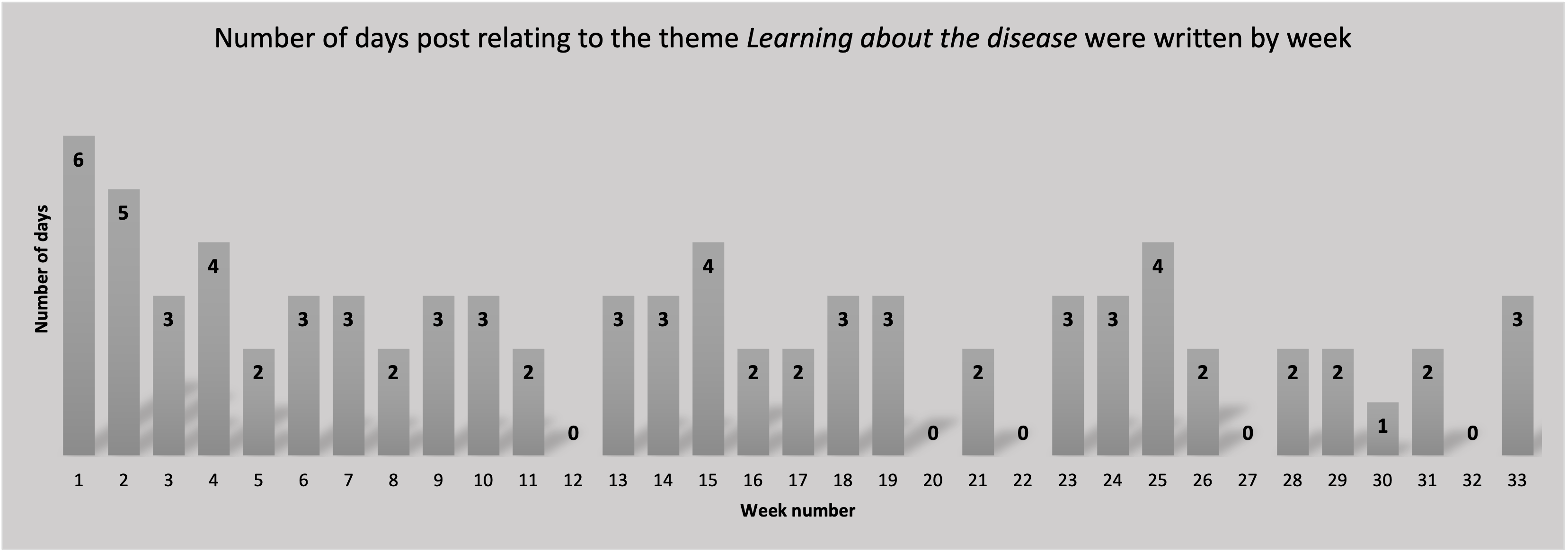
    From among the 237 blog posts, I coded 92/237 (38.8%) with the category, Learning about the disease. The distribution of number of days per week that I wrote one or more posts that were coded as Learning about the disease, Figure 4, shows interactions almost every week. This is particularly interesting because it shows that the learning did not just happen at diagnosis, rather I continued to learn and share my learnings throughout the study period.

    Number of days per week that a post was written that has been categorized as Learning about the disease.

    In reviewing the posts categorized as Learning about the disease, I constructed the following themes: (1) sourcing experts, (2) sourcing the Internet, (3) sourcing academic articles, and (4) sourcing peers. The theme sourcing experts applies to posts where I echo the information I receive from healthcare providers. The theme sourcing the Internet applies to posts where I include information from trusted Internet sources. The theme sourcing academic articles applies to posts where I include references to academic literature. The theme sourcing peers applies to posts where I describe information that I have gathered from peers such as through support group meetings. Peer sources includes blog posts of other cancer survivors. I discussion each of these themes in more detail in the in the following sections.

    Sourcing experts

    When I was initially diagnosed, I knew very little about breast cancer. In my early posts I would parrot back of the words I heard from my healthcare providers. For example, in It all started… (June 14, 2014) I say, “I’ve been told that the majority of women who get breast cancer do not have relatives with cancer”. As I gather more specific information, I include my interpretation and feelings associated with the information I’m receiving. For example, in Double-Mastectomy and chemo (June 19, 2014), I write not just about the disease characteristics, but also what those characteristics mean and how that translates into a treatment plan. At this point, I am echoing the information the I received from an oncologist. I’m not referencing any other source. More importantly, in this post I’m not just talking about the data itself (that is the pathology), I’m also talking about what that data means and how that information affects the recommended treatment options.

    Sourcing the Internet

    Within support groups, I often heard the women say to someone who is newly diagnosed ‘do not look at the Internet’. And yet, it was the Internet that I went to when I needed to look up medical terminology. When interpreting my pathology report, I tell readers of my blog that if they want more information on how to understand pathology reports, to look at http://breastcander.org. I refer to this site several times within the blog, as it provided useful information regarding breast cancer and treatment options.

    When I wanted a description of medical terms, or when I wanted to validate something that I heard from either support groups or healthcare providers, I went to trusted sites on the Internet. In Significance of dates and getting ready for chemo (June 26, 2014), I write about my reflections on the chemotherapy preparation class that my husband and I attended. I share a couple of resources: a book that I found to be not very useful; and, a website, http://chemocare.com, that was very useful. I find it particularly interesting that advice is often given to ‘not look at the internet’, and yet the better and more current resources shared are those found on websites rather than books, which quickly become outdated.

    Sourcing academic articles

    Initially, I was unable to read academic sources, rather, I relied on my husband to do that research. However, when I had to make a decision regarding surgery, I reached into the academic literature to do an analysis on what the surgery and the expected results of neoadjuvant chemotherapy. For example, in Breast reconstruction – academic analysis (September 22, 2014), I write about the knowledge I gained through reading academic articles relating to the type of breast reconstruction surgery I was debating. In addition to sharing some of the key findings from the academic articles, I also shared terminology definitions such as “Autologous reconstruction is reconstruction that involves the patient’s own tissue (e.g. DIEP flap, TRAM flap).” In Pathological Complete Response (September 23, 2014), I write about the knowledge I gained, and my interpretation of academic articles associated with the expected outcomes of neo-adjuvant chemotherapy. I not only provide key findings, but I provide my commentary on the findings. I’m sharing both the findings from the articles and my interpretation of that information and how it applies to my situation.

    Sourcing peers

    In addition to healthcare providers, friends connected me to a fellow breast cancer survivor. I see echoes of conversations I had with here in my blog, for example when I say “choose who you want to trust, and then trust them” (A long day, June 19, 2014). By the time I was to start treatment, I was familiar with some of the expectations around treatment. For example, in This too shall pass (July 16, 2014), I say that “during support group last Saturday, one of the ladies explained what the Neulasta bone point felt like. I had been warned.”

    Perhaps the biggest benefit from support groups was the normalization of medical terminology and the generic breast cancer treatment process. Specifically, in A photo shoot and getting ready for surgery (November 18, 2014), I write about the process of the surgery. I specifically talk about the “injection of some nuclear isotope into each breast that helps to identify the sentinel node, and the insertion of wires to guide the surgeon to the exact location of each of the tumors”. By the time I wrote about the procedure, the concepts had been ‘normalized’ for me. I had heard about it so many times at support group that I came to think of the process as ‘normal’. It was just something that I needed to do. Further, in Breast reconstruction – Academic analysis (September 22, 2014), I point to another blogger’s post before I refer to the academic literature: “First off, I should start by pointing out an important blog post written by Nancy Stordahl on why breast reconstruction is not a boob job (2013). When looking at patient satisfaction, I focused on post-cancer reconstruction which is a lot more complex than cosmetic reconstruction.”

    I don’t share a lot of the medical information that I received in support group. In part because I often validated this information with my healthcare provider and then reported it in my blog as being from my healthcare provider. In Flyin’ (November 26, 2014), I write about information that I learned from various support groups pertaining to lymphedema, and then how I looked into the academic research about it, sharing some key points from the research. Here I am showing how the information I received through support group helps me know what to look up, but also how I do not directly trust the information in support group, rather I look to more trustworthy sources.

    Summary

    In order for patients to be partners with their healthcare team in making appropriate decisions, patients need disease-specific information (Wallberg et al., 2000). When I was diagnosed, I knew almost nothing about breast cancer. I needed to use multiple sources in order to learn about the disease. My analysis of the category Learning about the disease shows that I continued to learn about the disease throughout the treatment process. Under the category of Learning about the disease, I constructed the following four themes (1) sourcing experts, (2) sourcing the Internet, (3) sourcing academic articles, and (4) sourcing peers. Within these information sources, I did not only share the information directly, I also shared the way in which I was interpreting the information. In addition, as time progressed, I increased where I received my information, using multiple sources to validate what I was learning.

    I began my learning about breast cancer through information I received directly from expert sources, that is my healthcare providers. When I needed clarification on terminology or more detailed medical information, I sought out trusted Internet sources. When I was ready to read academic literature, I searched the literature for information that would help me make treatment decisions. The different information and advice sources sometimes overlapped, where at other times they didn’t. I had to learn how to discern not only where I could get information, but also what types of information I could get from where, and how reliable that information was. There were so many nuances to information that I didn’t always appreciate at the time, and some that I still don’t appreciate. Throughout the process I negotiated the information that I received from expert sources, Internet sources, and academic sources. Although I gathered information from peer sources, I did not directly trust that information, rather I used trusted sources to validate what I had learned through peer sources. Patients experiencing critical or chronic illness have a need to learn appropriate sources for different types of information to help them learn about the disease and what it means to live with the disease.

    Where do you find your health information? What sources do you find reliable? Where do you learn about how to live with the disease?

  • Never knew I wanted to be a breast cancer survivor

    Never knew I wanted to be a breast cancer survivor

    I have finally taken the leap and published my breast cancer memoir: Never knew I wanted to be a breast cancer survivor.

    This memoir began as a Autoethnographic PhD study. I analyzed the first year of blog posts written on BC Becky, my breast cancer blog. My analysis involved constructing themes. The themes helped me choose which of the blog posts made their way into the book. Over the next several blog posts, I’m going to share the results of my analysis. For starters, the themes I identified are:

    • Developing coping mechanisms
    • Navigating the healthcare system
    • Learning about the disease
    • Understanding side effects
    • Advocating
    • Exploring body image
    • Making decisions
    • Negotiating identity

    I came to the conclusion that these themes aligned with patient health literacies that I developed throughout my treatment experience.

    Patient Health Literacies – (c) 2020 Rebecca J. Hogue

    If you are reading the book, can you see these themes? Do you see any other themes in the book?

  • Privilege and equity in health care

    I shared the other day the idea the for the privileged equity feels like oppression.

    It occurred to me that this is in part why I am scared at the idea of moving back to Canada and relying on the Canadian healthcare system. The Canadian system is a good one. It is mostly equitable. It suffers from the same issues as most, in that people in rural areas don’t get as good care as those who live closer to major medical centres. That issue exists in the US too.

    But, at the moment, I’m extremely privileged when it comes to healthcare. I have good insurance. For the most part, I have access to excellent doctors, and I can afford my medicines. I have learned to use my privilege to get good healthcare.

    Going back to a more equitable system means I will lose my privilege. I will need to learn to navigate a different system. I will still have some privilege because of my education, but it will be much less than I have at the moment, in the vary inequitable American system.


  • Precision social media support – an #epatient example

    In early January, I joined Christopher at Just Talking for a podcast. One of the topics that came up during the podcast was the role of social media (and in my case Facebook groups) as patient support when going through illness.

    I spoke of my experience with Facebook groups relating to my choices are breast cancer surgery. Early in my treatment I was certain that I was not going to opt for reconstruction. I joined this awesome Facebook group called Flat and Fabulous. The women in it were a constant source of support, not just around the decision to go without reconstruction, but also on other aspects of learning to live with breast cancer and managing side effects of chemotherapy. I know that at any time of day I could post a message and I’d receive encouraging and informative responses.

    When I decided that I would opt for reconstruction after all, I had to leave the flat and fabulous group. Their guidelines were clear – they were there to support those who chose not to reconstruct. They were not making any judgement or value statements, just that they have a clear niche and want to keep it that way. And so, I left the group, and found another group – this time, the group I sought out was one that supported the specific type of reconstruction surgery I was having. This too proved to be very valuable to me, as I had 24/7 access to women who knew what I was going through. When I had a weird symptom I could ask, is this normal? Is this something I should call my doctor about immediately? or is it something that can wait until the next appointment? The group helped me prepare for my surgery and helped me be better prepared for what I would be experiencing in the aftermath of the surgery – all the little (and not so little) things the doctors forget to tell you.

    What is interesting about this is that I was about to find Facebook groups that aligned with where I was in treatment, and that as my treatment changed, I was able to find groups that aligned with those changes.

    In the pod cast, Christopher mentioned a connection to the concept behind precision medicine. The idea being that rather than giving one treatment for everyone, that we use some characteristic (in the case of precision medicine it is molecular makeup of tumors) to determine treatment. So, it is isn’t a one-size-fits-all, but rather a more personalized approach. In some ways, social media can provide this. In my case, it was with Facebook groups – there are so many different Facebook groups around the different areas and treatments for breast cancer that I was able to move from one group to the next when I needed to. I could find one or more groups that supported me in the stage / phase that I was in. When the group no longer aligned with my needs (or treatment choices), I was able to find another group that worked better for me.

    It makes me wonder if others who use social media for health support, if they do the same thing? Is the movement from one group to the next common?

  • Study idea: Comparing pt peer SE advice with care team SE advice in MBC pts

    While I was hiking yesterday I had a thought for a study I’d like to do – or at least research whether anyone else has already done it. Of course, I cannot even think about it until I’m finished with my dissertation research, but I thought I’d write it here so that I don’t forget, but also to see what others thought about it. If anyone has any suggestions on where / how one might get some funding to study this I’d love your suggestions. A grant of some type would give the study some legitimacy, however, at this time I’m not affiliated with anyplace that could do that.

    Anyways, more to the point, the study idea. The title would be something like: Comparing online peer-to-peer support with oncology care team support relating to chemotherapy side effects in metastatic breast cancer patients.

    Part of what got me thinking about this has been conversations with my friend Lori Wallace. She has metastatic breast cancer (MBC) and is very involved in the patient online communities. When she learns something that might be helpful, she makes a note of it.

    When Lori begins a new chemotherapy regime, she looks up her notes and asks others about the side effects. She recently started Xeloda, which has a common side effect of “hand and foot syndrome”, where the skin on the hands and feet get paper thing and dry – the folks at Chemocare describe it as similar to having a sunburn on your hands and feet. One of the suggestions she had learned from her support group was to take 400mg of vitamin E. This is something her oncologist, who is truly amazing, had never heard of. Lori describes it as “It makes a subtle difference, but it HELPS and that’s a big deal. It’s the difference between walking with with painful feet and walking with bloody, raw painful feet. Feet hurt either way, but with Vit E, it’s at least possible to baby the feet a few days, then do normal things and “beat them up” without all ones skin peeling of and bloody fissures.”

    Another thing that Lori learned from her support group was that Ritalin could help with the debilitating fatigue she was experiencing. It turns out that her oncologist had heard of it, but that it is not approved for that purpose. As a result, her oncologist could not suggest it. In the end, Lori went to one of her other doctors (palliative care or family medicine) in order to get the prescription.

    These are just two examples of the type of information that patients are gleaning from each other through online support groups. It isn’t necessarily that the health care team doesn’t know – more that they are not empowered to share – but also that they don’t always have the time or motivation to seek out ways to reduce some of the sometimes rare side effects of a given chemotherapy regime. Patients on the other hand are motivated to find that information. When you are suffering, you reach out to those who understand and appreciate your pain, and can offer some ideas on how to make your life better.

    I want to highlight that this is very different than snake oil type “cures”. This is not people who have no experience with the illness lecturing on what might work – rather it is people that do know exactly what it is like to live with the illness or side effect, and can share the things that make a “subtle” difference that really is the difference between having a good day and having a bad one – and when your days are few, every good one matters.

    I also want to highlight that the information received isn’t always useful and in some cases does cause harm. This is part of the balancing act patients of critical and chronic illness need to learn how to navigate.

    For a research study, I was thinking of looking at what knowledges MBC patients share in their online support groups, and how that compares to the knowledge they gain from their healthcare teams. I’d also like to contrast that with the information that oncology teams receive from formal healthcare training (e.g. continuing medical education courses and conferences). I want to articulate the role that online support groups play that is beyond providing social support. We know that social support is provided by these groups, but there is also medical information provided. There is also patient empowerment support. There are real suggestions that make a huge difference in quality of life for patients. I’d like to look at this and formalize what is happening within these communities and associate it with the role of ePatients in the future of medical care.

    Now, my question for my readers, does this sound like a needed/good study idea? Does anyone have any idea of organizations that might be willing to fund such a study? 


  • Paradox of Patient Empowerment and Care

    I find myself looking at all my past experience, and making connections between what I know as an educator, and PhD student, to what I have experienced as a patient with critical/chronic illness. Leading off from Autumm Caines’ post about Virtually Connecting focus groups, I want to chat a little more about the paradox of patient empowerment and care. I watched the first focus group and attended the second and third. It was during the third focus group that I was challenged on using a famous Audre Lorde quote “you cannot dismantle the master’s house with the master’s tools” – that challenge led to an ah-ha moment for me – the paradox of patient empowerment and care.

    When we talk about the need to empower patients, we talk about patients taking an active role in their healthcare. This is a challenge the often very paternalistic healthcare system – where we as patients are suppose to do what we are told. The language often used is that of “compliance”. It goes further to sometimes even blame the patient. We hear things like “the patient failed to respond to this medication”, rather than “the medication failed the patient”. Language matters.

    In one breath, I see patient empowerment as giving patients a larger voice in the healthcare system. I talk about medicine being practiced with patients rather than on patients.

    On a side note, I wonder how much of this is an American view point – where here you often (if you live in a populated area and have the privilege of good health insurance) get to choose who provides your healthcare? This is the land of second and sometimes even third opinions – but it is also the land of shopping for healthcare providers that align with your needs/personality, etc. The choice of provider affects the culture. I do think the empowerment situation is somewhat different in a socialized system, where you don’t have the choices in who you see (at least not to the same extent). In Canada, the gatekeeper is your family medicine physician (primary care physician or PCP). When you need a specialist, you go through your PCP. In the US, at least from my experience, your insurance company plays a much larger role of gatekeeper. Your insurance company determines if your PCP needs to make a referral or if you can self-refer. Your insurance company (and bank account) determine which providers are in-network – and which ones you can afford to see. In many cases, self-referral is what happens. When I was diagnosed with cancer, once I had a confirmed pathology, I could self-refer to any surgeon or oncologist. I didn’t need my PCP to make the referral.

    Where do I see the paradox? I see it in the need for the healthcare system to provide care. When you are in the middle of a health crisis, you need to know that the healthcare system is going to care for you. You need the maternalistic sense that someone(s) has your best interests in mind, and that they will ensure you are cared for. When you are in crisis, you don’t need, nor do you really want empowerment. You need care.

    Going back to the Audre Lorde quote “you cannot dismantle the master’s house with the master’s tools”, the patient empowerment movement isn’t so much about dismantling the tools completely, although it is about dismantling some of the paternalistic tendencies in the system. There are times when we need the use of the master’s tools. We need the expertise of our physicians and other allied health professionals. We rely on them for care. But when we are not in crisis, we also need to know that our voices are heard.

    In online teaching, we talk about the transition of teacher from “sage on the stage” to “guide on the side”. In many ways, this is the transition that empowered patients are looking for in healthcare. They want their physicians to be guides rather than sages. The expertise is desired, but also the recognition that patients carry prior knowledge and expertise. I like to use the phrase “I am an expert in my body”. My medical oncologist is an expert in breast cancer and the pharmaceutical treatments for it, but he is not an expert in my body. I am the one that is living in it.

    Do you see a paradox between patient empowerment and care? How is patient empowerment different in socialized medicine settings? 

  • Intersectionality, Identity, and Health Humanities #healthhum2017

    The last couple of days I’ve been attending the Health Humanities Consortium conference in Houston Texas. The experience has been rather mixed for me, causing me to reflect on so many different things. One of the themes of the conferences was that of intersectionality. The idea that we all carry a variety of identities, and it is sometimes the combination that makes our experience important/special/unique.
    It is my intersectionality that makes the sharing of my experience valuable. In part because my privilege and my abilities allow me the voice to share my story. I need to own my own identity. I’m a white, hetero, ’new’ scholar, Canadian, California resident, female, ‘young’ breast cancer survivor and someone with celiac disease …. and much more. Each of these things played into my experience at the conference.
    I found myself challenged as someone who came to this conference not knowing anyone – new to this community and the scholarship of this community. My initial attempts to interact with people didn’t feel well received/reciprocated and this took a lot of energy from me. Something that I’m realizing that I have a lot less of post-cancer treatment.
    I found myself as an expert from the ePatient experience – annoyed when I heard the rhetoric of “everyone is a patient” as those of us dealing with critical and/or chronic illness can attest that our experiences as patients in the healthcare system are dramatically different than those who experience temporary illness.
    When I heard about medical humanities programs I found myself wondering if there was room for an ePatient stream. What do I mean by that? I mean that I don’t see a clear place for peer-to-peer patient experience, nor patient advocacy within health sciences. I see a need for an ePatient track – where ‘insiders’ have a space to explore their experience in an academic setting. I think health humanities might be the right place to place that type of exploration.
    I find it interesting that it has never occurred to me that perhaps disability studies is the home for this type of work. I have never related to it, until I started typing this it had not occurred to me that there might be a place there. That being said, I don’t necessarily think of critical and/or chronic illness as disability. I feel there is a difference, but cannot figure out how to articulate it. Perhaps it is because I don’t think of my chronic illness as a disability (although technically both cancer and celiac are legally considered ‘disabilities’).
    I found myself thinking, wouldn’t it be nice to see more ePatient academics presenting, or even ePatients who are not academics, to help balance the outsider perspective that is prevalent in the scholarly spaces. The problem is, those who are insiders aren’t necessarily willing to share their insider experience – especially in health fields where the predominant line of research asks that we be ‘objective’, denying our personal relationships to the discourse.
    I found myself challenged by the food – or lack their of. I’m a celiac. It means I need a strict gluten free diet. The organizers did a great job of setting aside a special lunch for me, so that I had an option. The problem is, special often gets lumped together. I’m not sure if this is a caterer problem or a conference organizer problem. I am not a vegan. I need protein. I also don’t eat soy. I really really don’t like it when I get gluten-free bread in my GF meal. Why? Because I cannot tell – it is too easy for the GF bread to get switched for a non-GF bread. I really want a GF meal that LOOKS like a GF meal, one that has protein, and one that I can trust. The is hard when you are attending a conference that is out of town. It hard when there aren’t a lot of options that are within walking distance of the conference. It is an invisible disability. Dealing with food takes a LOT of extra energy.
    At times, I found myself challenged as both a novice and an expert at the same time. I didn’t know where or how I might fit within this community – and yet I found the presentations I attended all captivating. I found myself relating more when then speaker quoted the seminal characters in education and critical theory – in part because I have some background there. I struggled more when the links where to literature, having never taking a lit course!
    My thoughts came full circle today when I attended a session today where several scholars talked about teaching using Audre Lorde’s The Cancer Journals. I’ve been thinking of writing a piece that juxtaposes her diaries with my experience. When the first scholar talked, I found that I was questioning myself. Who was I, someone who did not share her intersectional identity, to compare my experience to hers? Why would I have the right to do so? But then I thought, I’m allowed to have my experience. My intention with such a paper is to describe both the differences and similarities to our experiences. I think the exercise will be useful, even if it doesn’t result in a paper.
    Although I had a mixed experience with this conference, I do plan on attending next year, largely because it is at Stanford – which means I don’t need to travel. It means that I can sleep at home, but also that I can easily pack my own meals. Having more energy to experience the conference itself, rather than dealing with all the energy (and pocket book) sapping issues associated with conference travel.
    I’ll be thinking a lot more about this experience and my intersectionality as I consider where I might end up when I finish my PhD.
  • Oppression?

    Maha Bali’s latest blog post on Unpacking terms around equity, power and privilege has got me thinking (actually, I was thinking about it just yesterday, but her post has prompted me to write more about it!). I’m slowly making my way through Freire’s Pedagogy of the Oppressed.

    “But their perception of themselves as oppressed is impaired by their submission in the reality of oppression” (p. 45)

    I’m trying to put this all in context to my research – looking at my lived experience as a breast cancer patient. I am struggling with some of the language. Is what patients experience oppression or is it simply a power imbalance – which doesn’t necessarily mean oppression? But then Freire has me asking myself if my perception is impairing my ability to see the reality?

    Is it oppression when the end goal is caregiving rather than profit making? The purpose of the healthcare system is to care for patients, although there is certainly a level of profit making that is at play. In the US, there are a lot of times when your insurance affects your treatment options. Insurance companies seem to be the ones holding the power here, rather than medical professionals. In that essence, it is both the physicians / care providers and the patients who are in the subservient /oppressed role.

    “the oppressed, who have adapted to the structures of domination in which they are immersed, and have become resigned to it, are inhibited from waging the struggle for freedom so long as they feel incapable of running the risks it requires” (p. 47).

    As a patient, there is a risk of me rocking the boat too much. If you complain too loudly in the US system, you run the risk of being fired by your healthcare providers. That being said, if your healthcare providers suck too much, you often have the ability to change providers. If the ACA (Affordable Care Act otherwise known as Obamacare) gets revoked, then there is a huge risk of the patients who are the worse off already, being unable to get insurance. This adds a layer to the disempowerment of patients. In Canada, what I’ve seen in this situation, is that the patient just loses access to care completely. If you complain loudly enough, doctors stop seeing you – and you don’t always have options (especially if you are located in a rural setting).

    Another place where I personally see struggle is around wait times. In the US, I am privileged to have good insurance. This means that I have easy access to healthcare. In many cases, the wait times are short. I’ve come to the expectation that I get responses from my care team within 48-hours of sending in an email requires. That type of response is unheard of in Canada (frankly, so is emailing care providers!). If I need to wait a couple months for a procedure or specialist appointment, I find myself complaining – but the reality it, my privilege in the US means that I have access that far exceeds what I’d get in Canada.

    Canada has a much more equitable system, but it suffers from huge wait times. In Canada, the only privilege I carry is that I’m educated enough to ask questions. I’m able to figure out aspects of the system that others cannot, and yet I’m still placed in the queue just like everyone else. My privilege does not buy my way to the front of the line, but it does give me the information I need to ask the necessary questions to ensure that I’m waiting in the shortest line.

    And so, I’m in the position of having adapted to the structures of domination, and I know a fair bit about how to play the games I need to play to get things done. With that, I’m hesitant to want to rock the boat, for fear that it would impact my personal healthcare.


    “Any situation in which ‘A’ objectively exploits ‘B’ or hinders his or her pursuit of self-affirmation as a responsible person is one of oppression” (p. 55)

    So this goes right back to my original question. When I’m looking at the patient experience within the healthcare systems, is that one of oppression? The system is intended do provide care, not exploitation. There are definitely power imbalances within the system, but does a power imbalance mean oppression? What do you think?

  • Patient Health Literacies

    In Arthur Frank’s (1995) seminal book The Wounded Storyteller, he cautions “On rare occasions when I have taught this book, students’ biggest initial difficulty is to stop reframing everything ill people say into a question of how some health-care worker might respond.” (Location 115)

    I often find myself falling into that trap. I find myself thinking about my research, and the focus on peer-to-peer patient learning, and yet seem to feel that the value in the research is in the change in how health-care workers respond. Really, my focus should be a change in how my work can help patients and caregivers find agency within the healthcare system.

    This idea of value of knowledge (or value of literacy) is something that Brian Street talks about in Social Literacies: The Schooling of literacy. I talked a little about it in my post on critical digital health literacy. In the chapter I’m reading now, Street (1995) talks about how the definition of what literacy is (the value proposition) is defined by the dominant culture. When we talk of a critical literacy, we are turning that around and looking at it from the perspective of the non-dominant – perhaps those who are seen as not literate.

    In the health literacy context, we see the definition of digital health literacy from the perspective of healthcare systems –  “the ability to seek, find, understand, and appraise health information from electronic sources and apply the knowledge gained to addressing or solving a health problem” (Norman & Skinner, 2008, para. 6). To me, this definition feels like what health professional want patients to have, not what patients necessarily want or need. The health literacy definition is from the perspective of the dominant culture. It is also very solution oriented – as if there were only one solution to the “health problem”. The human body is complex. It is a complex system. There are many different ways in which to approach a health problem, and not all of those involve solutions.

    Now if I look at it from my perspective as a patient, and not a healthcare professional, I can see literacies in a different light. If I look at what I consider important to be “health literate” from a patient perspective, I’d say:

    1. Understanding the disease well enough to explain it to both non-medical professionals and medical professionals (knowing that the language of the medical profession is not the same as the language used by the general population).
    2. Understanding the healthcare system well enough to get the care you are looking for. This in part means knowing who to ask which questions to, and knowing even what things are available to you as a patient. Understanding the hierarchies within the healthcare system helps to ensure you are asking the right people the right questions.
    3. Knowing where to go to get support from peers.
    4. Knowing how to identify individual experiences of disease experience versus generalized experiences. That is, developing an understanding of what aspects are typical and what aspects are unique to the individual experiencing the disease.
    5. Understanding the disease well enough to search for information on the internet, and discern appropriate sources of information (e.g. being able to identify snail oil).

    My question to you is, as a patient, what you see as the important things YOU need to know in order to manage your personal health? 

    Feature image: By NASA/MSFC/David Higginbotham – NASA Image of the Day, Public Domain, Link

  • Critical Digital Health Literacy

    Digital Literacy – Read, Write, Participate (e.g. https://learning.mozilla.org/en-US/web-literacy)

    Digital Health Literacy – “the ability to seek, find, understand, and appraise health information from electronic sources and apply the knowledge gained to addressing or solving a health problem” (Norman & Skinner, 2008, para. 6).

    Critical Digital Health Literacy – the ability to seek, find, understand, and appraise health information from electronic sources to not only apply the knowledge gained addressing or solving a health problem, but also to participate in the healthcare system.

    Aligning with the discussion I just finished on Open Dissertations, I have decided to share a half-baked (draft) idea with you. One might say that this blog post belongs in the land of not-yetness :-).  I welcome discussion and feedback – and reference for articles/books I should read. I use the term healthcare provider to mean any healthcare professional, including doctors, nurses, therapists, etc.

    Digital health literacy has been defined as “the ability to seek, find, understand, and appraise health information from electronic sources and apply the knowledge gained to addressing or solving a health problem” (Norman & Skinner, 2008, para. 6). I want to explore this further, as I feel that the definition is not complete. It touches on the technical aspects of digital health literacy, but misses the contextual issues and social issues associated with developing a new literacy. It also doesn’t address patients’ participation in the generation and dissemination of health related knowledge.

    “The questions that have mostly been asked by agencies attempting to introduce literacy to societies where it is not been widespread, have generally stemmed from emphasis on the technical problems of acquisition and how these can be overcome.” (Street, 1995, p.28).

    “By definition, literacy is being transferred from a different culture, so that those receiving it will be more conscious of the nature and power of that culture then of the near technical aspects of reading and writing.” (Street, 1995, p.30)

    Street’s (1995) description highlights a challenge in Norman & Skinner’s (2008) definition of digital health literacy, as the focus is on the technical acquisition of knowledge as is defined by health professionals. However, those that are receiving this health information are not from the dominant culture – where the dominant culture can be seen as the language of healthcare professionals. So, the problem of digital health literacy from a patient perspective is in the application of health information into the specific context of that patient, where the context includes medical condition but also the country and the culture of the patient and healthcare provider.

    “In many situations it is the dominant group within a society that is responsible for spreading literacy to other members of the society into subcultures within it” (Street, 1995, p.30)

    We see this in healthcare education. It is healthcare professionals (dominant group) who are responsible for educating the patients. Street (1995) highlights that literacy is not just a learning of new skills but also involves “profound changes in people sense of identity and then what they took to be the basis of knowledge” (p.31). In the context of critical health literacy, the patient identity and role shift from a passive patient who follows doctors orders, to a patient who works with their healthcare team to come up with treatment plans that work for that individual patient. Health literacy involves a shift in power, but not a total shift, from healthcare provider to patient, allowing the patient to take some control over their healthcare.

    When it comes to digital sources, the definition of what is considered useful or valid is from the perspective of the dominant group – the healthcare provider. However, many patients also value information that comes directly from other patients, rather than information that is pushed down from healthcare providers. Patients are the experts in their own lived experience, however, lived experience information is not valued by many healthcare professions unless the patient is also a healthcare professional. For example, when a medical doctor who gets cancer then blogs about their patient experience with cancer, their blog is seen with a much higher regard than a blog by someone who is not a healthcare professional. However, that doctor doesn’t experience the patient role the same way patients who are not doctors experience the patient role. Again, we have someone who is in the dominant culture being given more credibility and yet their experience is not representative of the experience for those who are not in the dominant group.

    I feel like what I’m trying to do here is to provide validation for the sharing of patient voices in the language that patients understand. The goal is not upward communication, that is, the goal is not to allow patients to better communicate with their healthcare providers, rather the goal is to help patients better understand their experience using language that they understand. We see in patient blogs the adoption of medical terminology. Patient bloggers do not make up a completely new language, rather, the language use is a mixing of the medical terminology with the non-medical language that is used by everyday people. So the focus is on peer-to-peer ways of communicating.

    My argument is that one of the goals of critical digital health literacy is about giving voice to patient narratives for the purpose of helping patients better understand their lived experiences. I say one of the goals because I agree that a goal is to improve patient-healthcare provider communication, but I also want to add to it that there is also an aspect of patient-patient communication that is just as important or maybe even more important for those dealing with chronic or critical illness.

    Aligning with the goal of critical theory, there is a social justice cause in critical digital health literacy. This literacy helps to highlight the problems with the traditional methods of medicine where the doctor is see as the expert and the patient is in a subservient role as someone who healthcare is performed on rather than with. In traditional models the patient is a passive receiver of healthcare, rather than someone who takes an active role in their personal healthcare. Part of developing a critical digital health literacy is to help patients gain the knowledge and skills they need to find their own voice within their own healthcare. There is also a goal to help those patients who wish to advocate for change, the knowledge and skills necessary to do that advocacy work.

    On this front, my personal social justice activity was to create a course called Should I blog? (available at shouldiblog.org). When I created it, I had no thoughts of critical digital health literacy or what role the course might play in such thing. Now, I can see that it is a small part of what is needed to help patients find their voices, but also help patients find other patients so that they don’t feel so alone.

    References:

    Norman, C.D., & Skinner, H.A. (2006, June 18). eHealth literacy: Essential skills for consumer health in a networked world. Journal of Medical Internet Research 8(2). Doi: 10.2196/jmir.8.2.e9

    Street, B. V. (1995). Social literacies: Critical approaches to literacy in development, ethnography and education. New York: Longman Publishing.

  • Health (Illness) bloggers

    In my literature review for my research I came across a great article (Keating & Rains, 2015) on the social support health (illness) bloggers receive. The article does a good job looking at social support of bloggers over a three year period.

    One of the things that came clear in the article is the use of the term health blog rather than the term illness blog. It has really got me thinking. A lot of bloggers shy away from the term illness blog because of the negative connotation around it. My immediate thought was the opposite of illness blog is wellness blog, but the term wellness blog is already used for those who are promoting wellness (e.g. diets, exercise routines, etc). Although the health (illness) blogs are written by someone who is experiencing illness, the focus of the blog is often the personal journey – and that journey is someone trying to figure out what health looks like for themselves. I do like the more positive connotation that health blog implies.

    I pulled out the following findings from the article:

    “The results indicated that changes in support available from blog readers and from family and friends over the course of 3 years were significant predictors of changes in bloggers’ well-being. Increased support availability from bloggers’ family and friends was associated with a decrease in bloggers’ feelings of loneliness and an increase in their feelings of health self-efficacy” (Keating & Rains, 2015, p.1454)

    The article makes mention of the idea of strong-ties and weak-ties. Strong-ties would be those with close family and friends. These are the people you can call anytime. They are your primary support. Weak-ties are those of acquaintances. They are not necessarily your close friends, but they still provide support through your experience. In this case, bloggers often have weak-ties with other bloggers. These weak-ties also help in increasing the feeling of support and decrease feelings of loneliness. I think we need both.

    “The results also demonstrate the benefits of blog reader support and suggest that this type of support can serve as a unique resource about and beyond strong ties. After we controlled for changes in support available from family and friends, change in blog reader support was associated with decreased health-related uncertainty. Bloggers who reported an increase in support from blog readers across the two measurement periods also felt that their health condition was less unpredictable” (Keating & Rains, 2015, p. 1454)

    What really resonated with me here is the idea that reading blogs helped to make my experience with breast cancer treatment less unpredictable. I was able to read a lot about people who had experienced the same surgery and breast reconstruction – so I better understood what my experience might be like. You cannot fully predict your experience as each journey is individual, but it really does help to have some general ideas of what you might experience as well as some tips on how to better cope.

    “In addition, the findings suggested that bloggers who perceived themselves as being in better health at the first time point were less likely to continue blogging over an extended period of time. It could be the case that those who evaluated themselves as being in better health were less likely to perceive value in continuing to document their experiences” (Keating & Rains, 2015, p. 1455)

    The idea that we blog less when we are healthy is something that I’ve definitely seen and experienced. We often feel like when things are going right we have nothing to say. A blog post that says “today was normal” does not feel that interesting, and yet, it is an important thing to say. It is really important to celebrate the good days, so that the blog is also providing encouragement to other patients. When cancer bloggers stop blogging we assume one of two things (1) they are healthy and don’t think they have anything interesting to say, or (2) they have died.

    “Through connecting authors with individuals who are coping or have coped with a similar condition, blogs appear to be a particularly useful resource for helping individuals to better understand their illness experiences” (Keating & Rains, 2015, p.1455)

    As a blogger, and one who reads blogs, I completely agree. Reading other blogs did help me better understand my experience. Overall, I did find that this particular study aligned with my experience as someone who both authored and followed breast cancer blogs. Now I just need to get into the habit of using the term health blogger rather than illness blogger.

    Reference

    Keating, D. M., & Rains, S. A. (2015). Health Blogging and Social Support: A 3-Year Panel Study. Journal of Health Communication, 20(12), 1449-1457. doi:10.1080/10810730.2015.1033119

  • Making the private public – Why we choose to blog about illness #VCePt

    Over the last week and a half I’ve spent a lot of time meeting with people regarding my PhD research – it was one of the reasons I went to Ottawa and stayed as long as I did. Overall it was a very productive trip.

    One of my learnings from the trip was that I really need to think about my research as something that is inherently separate from what I do as a blogger and Virtually Connecting founder. I need to be able to continue doing the work I do in these areas. I need to be allowed to do it without the risk of breaching ethics requirements.

    A new Virtually Connecting project that myself and Susan Adams (@edtechinsight) launched was discussions relating to the ePatient space. I’m an insider in this space. I identify as a blogger in this space. On an aside, I had been looking for a different term than “illness blogger”, and “wellness blogging” is a totally different thing. I discovered that some authors are using the term “health blogger” and I will probably choose to adopt that term.

    Since I’m very inside the health blogging community, I know a lot of bloggers. This has meant that I can draw upon my blogger friends to have a conversation around why we chose to blog and why we share such personal details on the public internet. These questions were influenced by a session I attended at the #IHSRC35 conference last week. Researchers were trying to guess why we share what we do, but they were not inside the community so they left the session perplexed rather than with answers. This posed a great opportunity for Virtually Connecting ePatients (#VCePt) to provide a dialog that will be archived on the public internet and available for use by researchers (and anyone else who might be interested).

    If you are interested in watching or joining the session, links are available from the Virtually Connecting event announcement.

    I’m also looking for ideas about future topics for Virtually Connecting ePatient discussions. I’m thinking about using something like the Mozilla Web Literacy framework as a way to inspire questions relating to digital health literacies.

    What questions would you like to see addressed in Virtually Connecting ePatient discussions? How do we break the silos so that we are not just patients talk to patients – but rather we are having conversation between patients, healthcare providers, and researchers?

  • Usage guidelines for researchers who use blogs

    I’m thinking of calling out to the blogging community (more specifically to the cancer blogging community – but I’m sure this extends to other blogospheres), in trying to create some way to signify to researchers how the blogger wants their blog to be used in research. I’m thinking something similar to what creative-commons has done for the copyright community, I’d like to create something that is “informed consent” for the blogger community. Bloggers would then make the official statement in their About Me page. This would give researchers an indication for how the blogger wants their content used in research.

    Some of the statements might include:

    • When and how to reach the blogger (e.g. email, leave a comment, no need to contact)
    • What types of research I approve (e.g. all research, medical research, social media analysis, etc)
    • What uses of the blog are allowed (e.g. analysis use without prior permission, analysis only with prior permission)
    • What level of interaction does the blogger want with researcher (e.g. participatory research only, member checking required to ensure correct interpretation, no involvement in the research)
    • How should my blog be represented in the research reports (e.g. quote me directly, don’t quote me, anonymous contributions only)
    • What follow-up the blogger would like (e.g. contact me with research results)

    Those are a few things that immediately come to mind. I’m sure there are a bunch more. In the next week or so, I’ll look at how best to reach out to the larger blogging community to get their ideas on what this statement could say – then I can look at the best ways of categorizing things.

    Let me back and up start with the backstory on this. I’m looking at illness blogs in my research (more specifically the learning that occurs in breast cancer blogs). In doing so, I’m combing through the literature for anything written about illness blogs (or illness web logs, pathography, etc). As I read, I find myself a little frustrated that the far majority of researchers are both not bloggers and do not have critical illness. They are trying to be ethical in their methods, but they don’t have enough information to do so. They make assumptions based upon their field of study. What is ethical varies by field of study. For example, in social media analysis studies, anything on the public internet is fair game and does not require permission to use. So any blog that is not password protected, and any twitter chat is fair game for researchers. No approvals, no contact. In some circles it is common to use this public information logic as a reason to not need approval, but then remove names from quotes citing privacy. However, when I talk about researching blogs and ask if blogs represent “human subject research” I’m told yes, it-depends, or no depending on who I ask. If yes, then the bloggers in question need to give informed consent before their blogs can be used for research. I’m not sure happens if the blogger is dead (it happens when you research illness blogs). Then there is the issue of how best to contact the blogger. In some circles it is seen that if the blogger does not include an email address on their About page or in their footer, then they do not wish to be contacted. Anyone who blogs knows that the comments are how you typically reach a blogger – and especially if you are blogging about a health related issue and don’t wish to have your real name associated with your blog.

    My point is, the topic isn’t that straight forward. Researchers are well meaning, but they are making assumptions about what is ethical and what is moral based upon their specific fields of study. The voice of the blogger doesn’t play into the decision about how the blog is used in research. I want to change that. I want the blogger to be able to give official informed consent (or inform of their choices/preferences) directly in the About page of the blog. This will be especially useful in legacy blogs where the blogger has died and can no longer be contact to gain consent.

    Not exactly sure how to go about this, but I think it is something that is really important. I think that the blogger’s voice needs to be heard in the research space. I think that each individual blogger should have a say in how their blogs are used. I don’t think researchers should be deciding on what is ethical or moral, I think that is something the blogger should decide.

    What do you think? Do we need a blogger code for researchers? How would you go about making that happen?

  • My hybrid identity

    This last few days at the Stanford Medicine X Ed conference (and following along with the Medicine X conference), I found myself in an weird position of hybrid identity. My experience with medical education is with the work I’ve done with the Department of Family Medicine and Faculty of Medicine at the University of Ottawa. Through that work I’ve become a little bit familiar with Canadian Medical education. Although I’m not an MD, I understand some of the lingo. I understand a bit about how medical education works, and how residency education in family medicine works. I’m far from an expert, but I’m familiar.

    But as an engaged patient, my experience is all America. Sure, I’ve been a patient in Canada, but as Carolyn aptly puts it, my acute care episodes within the Canadian healthcare system don’t qualify me as a patient (or at least not as an ePatient). I do not have an ePatient view into the Canadian medical system. I do, however, have an ePatient view into the American (and more specifically the California) healthcare system. I have experience dealing with two different healthcare organizations. I have experience with the American system of choosing your healthcare team (this was really difficult for me to grasp at first). I no longer think twice about booking appointments for second opinions (which may be one thing that contributes to the high cost of healthcare in the US). From an ePatient perspective, my expertise is solidly planted within the US heath care system.

    The Medicine X Ed conference also made me realize that I really need to get some new business cards. Part of what has been holding me back is what to put on them. What do I call myself? How do I say who I am on a single card? How do I brand myself?

    When I met the super cool folks at Fusion Tech, I was a little embarrassed that the only business cards I had were ones that said I was a student at uOttawa or the ones from our Going East bike trip. I didn’t have anything that said I’m a blogger, write, associate lecturer (that a fancy academic title that says I work as a contingent part time instructor at a university) … or any of the variety of other titles I’ve given myself over the last 20 years.

    I have a couple more conferences coming up in the next couple of weeks (Health 2.0 and dLRN). I’m going to need to figure out those new business cards pretty quickly – otherwise, I’ll be in the same awkward position of handing out old cards that don’t really speak to who I am today.

  • “We are all patients” … NOT #medx

    One of the comments that was made, and repeated several times on the first day of the Medicine X Ed conference I attended last week was “we are all patients”.

    This caused me to tweet out:

    I had not really thought about the problem with this rhetoric before, but when I heard the statement I felt it. The emotional me recoiled at the statement. I felt that my experiences as someone who has undergone diagnosis and treatment for breast cancer, and someone who is figuring out how to navigate hormone therapy and celiac disease, who has spend the better part of the last year and half attending to two or more healthcare related appointments each week, was discounted as “normal”. My experience was in no way unique or special. Saying that “we are all patients” is saying that the patient experience is something that is normal.

    Carolyn Thomas of @heartsisters explains it well in her post: “We are all patients.” No you’re not.

    What really struck me though, was that my response to the statement was an emotional one. It wasn’t rational Becky disagreeing with the statement. It was emotional Becky feeling like my experience as a patient had been silenced and discounted. That my story was no longer an important story to be told. I was no longer an epatient ‘expert’.

    Of course, academic me knows better. Academic me heard it and saw a parallel to the ‘all lives matter’ argument that is sometimes used to silence the #blacklivesmatter movement. If you are not familiar with what is wrong with the ‘All lives matter’ argument, please read this great article by David Bedrick – What’s the Matter with ‘All Lives Matter’.  It is, perhaps, because I had read that article that I saw the parallel in what was happening at Medicine X Ed.

    I’m kind of sad that my tweet didn’t get more favorites or retweets. I think it is important that we stop saying ‘we are all patients’ at medical conferences and within medical education. Unless you’ve experience critical/chronic illness, you cannot even begin to imagine what it means to be a patient.

  • Tribes and autopathography

    I have blogged before about how one of the reasons I go to conferences is to help find my tribe. I’ve also said that I won’t go to conference unless I know a few people, as that is helps me be an insider, or at least a little connected.

    Last week I attended two conferences. The first, the ALT-C conference, I definitely felt was not my tribe. I was excited to meet some of my online friends, and excited to be Virtually Connecting with a few people that I had interacted with online and deeply respected. But the conference itself did not align well with my interests. It was very much a conference about Learning Technology in the UK. I don’t live there. I don’t understand the context. And, although I do stuff with online learning, I’m not really that tied to the practitioner focus. I did have some great interactions with people, however, it did not feel like my tribe.

    The other conference I attended was the Queens University of Belfast ePatient Blogging and Microblogging conference. Here I really felt like I was with my tribe. It is a new tribe for me. I was thrust into the world of being an ePatient when I was diagnosed with breast cancer last year. I immediately began blogging my breast cancer journey. I had some hope that it would be useful from an academic perspective, but I didn’t know what that would be. I knew that there was value in the reporting of lived experience through illness, I just didn’t know where that fit within the realm of academia. It was with that unknown lens that I did my presentation (part testimonial, part research report) – Cancer Blogging – A Survivor’s Journey.

    It was at this conference that I learned there is a methodology associated directly with the field of study that interests me – pathography, or more specifically autopathography. Dictionary.com defines autopathography as: an autobiography that focuses on or is inspired by the influence of a disability, disease, or disorder on the author’s life. Even more useful, I’ve learned about a field of study called the medical humanities, as well as several academic journals that publish the patients case stories (that is, autopathographies).

    You know you’ve found your field when you enjoy reading books about it. I’m now reading a book called The Wounded Storyteller: Body, Illness, and Ethics by Arthur W. Frank (who happens to be at the University of Calgary).  The book, among other things, talks about how illness narratives are a postmodern response to the very postpositivist healthcare system. As I read through the book so much resinates. Let me finish this post off with some interesting quotes from the book (sorry no page numbers, I’m reading the kindle version):

    On rare occasions when I have taught this book, students’ biggest initial difficulty is to stop reframing everything ill people say into a question of how some health-care worker might respond. (Location 115)

    Because stories can heal, the wounded healer and wounded storyteller are not separate, but are different aspects of the same figure. (Location 142)

    They need to become storytellers in order to recover the voices that illness and its treatment often take away. (Location 144)

    Sooner or later, everyone is a wounded storyteller. In postmodern times that identity is our promise and responsibility, our calamity and dignity. (Location 162)

    The story of illness that trumps all others in the modern period is the medical narrative. The story told by the physician becomes the one against which others are ultimately judged true or false, useful or not. (Location 280)

    The woman reported by Bourdieu seems to perceive that medicine has taken away her voice: medicine assails her with words she does not want to know and leaves her not knowing what. (Location 300)

    What is distinct in postmodern times is people feeling a need for a voice they can recognize as their own. (Location 302)

    Postmodern ties are when the capacity for telling one’s own story is reclaimed. (Location 304)

    This next quote is something that I think voices what I’m feeling regarding my illness blogging, my writing, and my desire to make meaning out of it within the context of the medical system. I want my writing (that is my story) to cross the postmodern divide – that is, I want it to have meaning within the context of medicine and medical education. I don’t want it to be secondary to my medical records. I want it to have the same weight as my medical records.

    The postmodern divide is crossed when people’s own stories are no longer told as secondary but have their own primary importance. (Location 309)

    The possibility, even the necessity, of ill people telling their own stories has been set in place by the same modernist medicine that cannot contain these stories (Location 314)

    Those who work to express this voice are not only postmodern but, more specifically, post-colonial in their construction of self. (Location 347)

    Our identity as people and the world we once knew both are relinquishes; we become their patients and we live in their hospital. (Location 351)

    For those whose diseases are cured, more or less quickly and permanently, medical colonization is a temporary indignity. (Location 353)

    This reducing of the particular to the general provided for scientific achievements, but that clinical reduction created a benevolent form of colonialism. (Location 362)

    In postmodern times more and more people, with varying degrees of articulation and action, express suspicion of medicine’s reduction of their suffering to its general unifying view. (Location 368)

    Post-colonialism in its most generalized form is the demand to speak rather than being spoken for and to represent oneself rather than being represented or, in the worst cases, rather than being effaced entirely. (Location 395)

    In Parsons’s sick role the ill person as patient was responsible only for getting well; in the remission society, the post-colonial ill person takes responsibility for what illness means in his life. (Location 403)

    Illness responsibility is reduced to patient compliance. (Location 433)

    Telling stories of illness is the attempt, instigated by the body’s disease, to give a voice to the experience that medicine cannot describe. (Location 472)

  • Quantified self and open research

    When Apple released its latest iOS with the “open” Apple Developer Healthkit to help promote the collection of data on mobile devices and have that data reach research scientists, I was encouraged by the potential. So many people have mobile devices that are already collecting health data, wouldn’t it be great if that data could easily be shared with researchers? Apple released the new Developer Kit with a few apps, one of which was targetted directly to those with breast cancer (Share The Journey). I downloaded the app, but was quickly disappointed. The background information didn’t allow for me to say that my treatment was “neo-adjuvant” chemotherapy – which is becoming more-and-more common – especially for treatment of aggressive breast cancers. When I submitted the feedback, I received a reply that the app used “validated measures” – which translates to “we used someone else’s data collection tools” – but the app authors did not account for new treatment regimes. Any data that I added to the collection would be invalid, but there would be no way for them to know that my data was not valid, because there was no way for me to say that I didn’t “fit” within the background survey. So, what I see with this app is garbage in = garbage out. I deleted it.

    I was Facetime’d into a presentation yesterday on technology, big data, and medicine. When I asked the presenter (Dr. Pavel Andreev) about the Apple Research Kit, his comment was that although it might be “open”, it is created by a company and limited to one platform. There is hesitance to build anything for a single platform (e.g. biased samples), but the bigger issue is that if there is no money in the platform, then the company could drop it. That is, if it doesn’t help Apple sell devices, then we may find that it isn’t supported in the future. For this type of application, an open-source / crowd-supported platform is preferred.

    I was really excited to hear about the Open Research, Open Data, Open Humans project (OpenHumans.org) – posted on the Quantified Self Blog today. I love the idea of the Open Humans project. It seeks to “break down barriers that make it difficult for willing individuals to access and share their data with researchers” (OpenHumans.org Press release March 24, 2015). Throughout my cancer treatment I collected a lot of data about myself. I always felt like it was such a waste that there was no way for the data to get into the hands of researchers. The academy (higher ed in general) spend so much time and energy protecting the privacy of individuals in research studies, that they do not allow for research participants to openly share their information. The model behind the Open Humans project is based on the premise that some people do want to openly share their information. Sadly, the initial studies are only open to US Citizens or permanent residents (I’m a resident alien). This is one project that I’ll be keeping my eye on.

    Would you be willing to openly share your data in the OpenHumans project?


css.php