Category: 1 Conferences

  • My #DevLearn conference insights – Day 2 & 3

    My #DevLearn conference insights – Day 2 & 3

    Keynote Augmented Human: How Technology is shaping the new reality

    What might not be clear from the title is that this session was all about Augmented Reality (AR). This was presented by Dr. Helen Papagiannis who is author of the book Augmented Human.

    I didn’t take a lot of notes during this session so I don’t remember too much about it – other than some of the discussions around the social impacts of Augmented Reality. I think this is a technology that is just starting to become more available – and so it will likely become more prevalent in the next few years.

    Best Practices for planning, developing, and implementing serious games

    This was an excellent session put on by Andrew Hughes (Diigo public library and presentation slides) from Designing Digitally. In the session he outlined several best practices including (these are from my notes, which aren’t the best):

    • Use badges only for competencies not just completion.
    • Show relative leader boards only – leader boards that show only the top scores can be demotivating. A relative leader board shows you how you can incrementally improve.
    • Provide continuous challenges.
    • Use compelling stories (this is an interesting link to the storytelling workshop I did on day 1).
    • Create parallel branches – that is that branching doesn’t work like a “tree” where each branch ends in a unique leaf, rather, the branches come together so that there are limited number of paths to the same one or two endings.
    • Give immediate feedback.
    • Show tangible results.
    • Fun is a metric. I really like this one. In addition to measuring success, you also need to measure whether or not students are having fun with the game.
    • Game play is important.
    • Theme does not matter.

    One thing that I noted from this session was a link to a question that a student had asked me. The student had asked me about how to assess a lesson that uses connectivist learning theory. Yes, that statement has a lot of challenges in it – first, is assessment something that is counter to connectivist learning theory? and second, is connectivism even a learning theory? But putting both those questions aside, I saw a link between assessing connectivist learning theory and serious games. If the games involve challenges that require collaboration, and require the need to reach out beyond the classroom, then the game itself could be a method of assessing a connectivist lesson. Maybe serious games is the answer to that problem?

    One statement that was mention has stuck with me – that is not to confuse compliance with performance, and don’t try to use compliance training/assessment to teach/assess performance. We all cringe when we think of the compliance training we are required to complete each year. Some of it is getting better – or at least is a little entertaining – but most of it is dry and boring, but a requirement none-the-less. However, performance training is different, because it is job-specific. The goal of performance training/assessment is to help employees be better at their jobs and improve performance. The goal of compliance is to check a box and not get a fine. The different purposes are important, and lead to very different types of training. Serious games align with performance improvement, not compliance.

    L&D Mystery series: The case of the disengaged learner

    This was an interesting presentation that followed along with the idea of using gamification as a way to present. The presenter, Cara North of Ohio State University, presented a bunch of techniques for engaging learners during presentations. She used Poll Everywhere well – as well as slides with hidden “easter eggs” to help the audience solve the mystery. It was an interesting technique to watch – although I cannot imagine how long it would take me to put something like that together.

    One of the features that Cara showed was the use of live Close Captions with Google Slides – she shows you how to enable it here. It is amazing how well it works. I just tried it out – and I encourage you to try it. I wonder how it would work with a screensharing tool like Zoom – if I share my presentation via screenshare on Zoom, would it also show the live captions? I’m going to have to test that.

    From start-up to global leader: Scaling training at the speed of business

    This was a different type of session that I found rather fascinating, not really because of the topic but because of the company that was presenting. The presenter was Elizabeth Wisch from The VOID. It was interesting seeing pictures of what their company does, but also hear about how they go about training when a new location is coming online. Next time I’m around one of these adventures, I’m now very curious to see what all the fuss is about!

    Better audio and video on a budget

    I attended this session because I do a lot of synchronous online video as well as recording a lot of online lessons. I wanted to hear what the presenter had to say. This session was presented by William Everhart of e-Learning Uncovered.

    The first comment he made, is one that we learned very quickly with our work with Virtually Connecting – that audio is much more important than video. It is a common mistake when doing Video Conferencing, is that everyone wants to focus on where the camera is pointed; however, if the audio is poor, then it is an impossible experience for the remote participants. This is also true for video – viewers will be much more tolerant of poor quality video than they will be of poor quality audio.

    I was glad to learn that the microphone that I use, although old, is still considered one of the better microphones out there – the Yeti Blue.

    One of the other things I learned that turned out to be very helpful for me a very short period of time later, was the direction of microphones. I attend virtually a design workshop where those who are onsite use a microphone. The session at DevLearn made me realize a common mistake people make when talking into the microphone – and that is that the microphone needs you to talk into the top of it, not the side of it. Once I remind people of that, they hold it appropriately and our audio quality is a lot better. There is a lot to be said about not just having the right equipment, but also knowing how to use that equipment properly.

    This reminds me of an equity issue regarding microphones. Anytime someone says “I don’t need the microphone, I can speak loud enough” they are actually making it difficult or impossible for some people to hear. If their are remote participants, then they definitely cannot hear anything that isn’t said into the mic – especially when the mic is directional. The mic is designed to not allow for any other sounds, and so the person shouting a question from the back of the room can be heard in the room but not online. Also, if anyone is using a hearing device, the microphone might be the only thing that is allowing them to hear what is happening. So, if the room is equipped with a microphone, and especially if you have remote participants, use the microphone. It doesn’t matter how loud your voice is!

    Tech Humanism: Shaping the future of meaningful human experiences

    To cap off the conference, the final keynote was about tech humanism and was presented by Kate O’Neill – Author of the book Tech Humanist.

    I recall at one point she pulled out a pair of augmented glasses (similar to Google Glass) and took pictures of the audience. One thing that was important here was that the glasses showed that she was taking a picture – in that as could see a blue circle flash like a camera lens when the picture was taken. Unlike Google Glass, those not wearing the glasses know that a picture was taken. There was some talk about how Google Glass lacked some of the important social cues that are needed for the technology not to feel creepy. I still felt that the AR glasses were creepy!

    One idea that I did take note of was the concepts of Privacy by Design. I have a vague recollection of having heard about this before. I think defining the principles is all well and good, but expecting people to follow them is a whole other issue. Call my cynical, but I don’t have a lot of faith in tech companies to protect my privacy.

    Impacts on my teaching and practice

    I found these two days to be very interesting, but will there be a direct impact on my teaching and practice?

    I don’t use gamification in my teaching – but my students do sometimes like to do a module on gamification. I think that I will encourage a group to do a presentation on gamification but rather than calling it gamification, I think I’ll reposition the option as “serious games” as I think that is something that causes deeper thinking.

    I’m also going to do some minor upgrades to my microphone setup to help improve the audio. I am planning on creating a scenario or two using Articulate Storyline 3, and in doing so, I think that improving my audio quality will help. This will also bring in some concepts from day 1 – specifically around using storytelling techniques to create compelling scenarios.

  • My #DevLearn conference insights – Day 1

    My #DevLearn conference insights – Day 1

    The first keynote – Sophia the robot

    The conference began with the initial keynote done by Sophia the robot. Honestly I would say that this keynote was not up to the standard of what I have come to expect of a DevLearn keynote. I was a little disappointed. I couldn’t help but think that this was just a robot body projecting the opinions of the engineers that developed it. It seems more like a gimmick than anything else. Perhaps I’m a little cynical.

    I did hear a suggestion from someone, not sure who, that it would have been nice to have a Q&A with the engineers – to help really understand how much of Sophia is AI and how much is preprogrammed. They did admit that the keynote was prepared in advance (now people do that too) as was most of the Q&A. There were a few questions that were asked there were not prepped and I was under impressed with the response.

    One of the questions that was asked in the Q&A was about the robots preferred gender pronoun. The robot has been given a female name and is generally referred to as ‘she’, which then begged the question, why is the robot a she? My response to that is that the robot is a ‘servant’ and that aligns culturally with female gender. A less cynical answer might be that Sophia is a ‘social’ robot and in our cultural women are seen as being more social than men. Further to the gender question, my question was, why is Sophia white?

    Using storytelling strategies to write compelling scenarios

    The presenter for the session, Hadiya Nuriddin, did a great job. Her presentation was a story in and of itself. Her presentation has encouraged me to check out her book, StoryTraining: Selecting and shaping stories that connect.

    The biggest takeaway I had was the use of the story spine – a great tool to helping write scenarios for eLearning. The spine goes like this:

    • Once upon a time …
    • Every day …
    • But, one day …
    • Because of that …
    • Because of that …
    • Until, finally …
    • And, ever since then …

    Next time I’m writing something for my online class based upon my experience, I’m going to try using this technique. She also mentioned that the story spine is something that could be used to frame interviews for subject matter experts.

    Connected Learning: How to harness the power of social, data, & networks

    The next session I attended was a lunchtime session on connected learning presented by Rose Benedicks. This was a vendor presentation based upon an free eBook they are offering available at: https://leolearning.com/resources/connected-learning-how-to-harness-the-power-of-social-data-and-networks/

    The one thing I learned at this session was a new term – LXP – Learning Experience Platform. It is the fancy new name for LMS within sectors that are not formal education. The argument is that “everyone hates their LMS” and the LMS space is super crowded right now, so some vendors have started rebranding themselves as Learning Experience Platforms rather than LMSs.

    Phaser 3: A free authoring tool for gamified eLearning

    I started out in this session but didn’t last long – largely because it had already been a long day and I was tired. The presenters highlighted that Phaser 3 is a gaming platform, not an eLearning platform. That being said, I could see how combing it with H5P and WordPress would give you a pretty decent set for free tools for developing cool things.

    One challenge that I have is the focus on gaming as gamification and losing the pedagogy in it. Also, the confusion between games and gamification or serious games (which I’ll talk to more in my next blog post). Don’t get me wrong, in this case the presenters did a really good job highlighting that Phaser 3 is a game building platform, not an eLearning one. For what it was, I think it was a good presentation – just not what I was looking for.

    Video Critique: The good, the bad, and the ugly

    This was actually a Tuesday night session that was put on for anyone arriving at the conference early. It was hosted by the DevLearn staff – and was pretty entertaining. The session involved showing a bunch of training videos and critiquing them. The videos were from various times and various countries.

    If you want to be entertained, take a look at the playlist: https://www.youtube.com/playlist?list=PLy1fKNjijAjzUw_jcHvY4_TIaWXfIUcIg

    As I write this, I’ve had a great idea. I think I’m going to select a few of these to use as a discussion around the use of video in learning for the course I teach called “Project in multimedia”. There is a module on the use of video, and I think this type of discussion – maybe done using VoiceThread so it can be done asynchronously – would be both a lot of fun and educational at the same time.

    Missed session on video

    There was one session that I missed because I was just too tired to keep going – and that was a session title Film School for Learning Professionals by Jonathan Halls. Unfortunately, I’m not seeing any info on his presentation on the eLearning Guild website – but I am seeing the presentations he has done in the past. It looks like he has some great resources on his website and shared on the eLearning Guild’s site from previous conferences. I’ll need too look more into those when I’m creating course material for next semester and summer.

    Impacts on my teaching and practice

    After the first official day in the conference, I had a few key things that will influence how I teach and how I design instruction. Specifically:

    • Using the story spine when writing stories for my training – and interviewing SMEs. Further, I’m going to read Hadiya Nuriddin‘s book on storytelling to see if there are any resources I can bring in to my Designing your professional presence course this summer
    • Introducing my students to the term LXP when looking at learning management systems in my online learning design course
    • Using the Good, Bad, Ugly playlist as a way to engage students in critiquing training videos
    • Exploring Jonathan Hall’s resources on how to create better video for training

    Further, one thing that I learned that doesn’t directly follow my practice right now, but might in the future: Introducing students to Phaser 3. I also noticed that no one mentioned H5P at the conference and might be an interesting thing to explore for future conferences.

  • Reflections on #DevLearn

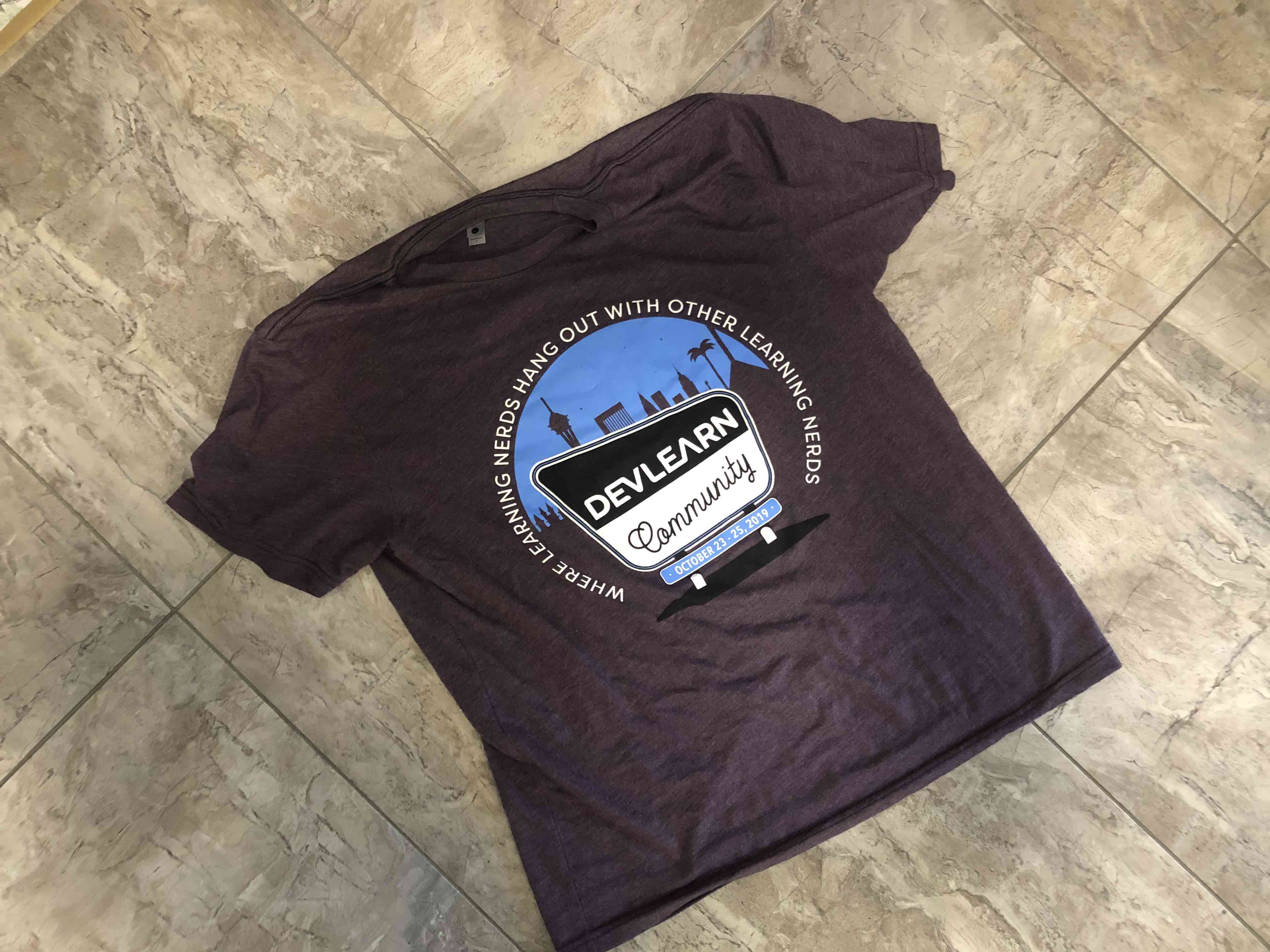
    Last week I attended the eLearning Guild‘s DevLearn conference. This is the best conference I’ve been to for professional development for Instructional Designers that focus on areas outside of academia. The primary audience of the conference are those involved in the creation of eLearning materials or infrastructure for the corporate sector. There are several folks from higher ed, but this conference is definitely not an academic conference. Since I teach instructional design, I thought attending this conference would be a great way for me to discover some new tools / ideas to support my teaching while getting a sense of what the latest trends were.

    The first thing that struck me about this conference was that all four of the keynote speakers were women. I’m sure this was an intentional effort on behalf of the guild. There was no compromise in quality – each of the women giving keynotes had impressive qualification. The first three keynotes were amazing. I was sad to miss the last keynote as I had to leave to catch my flight. If I go again, I’ll try to make sure I book things so that I don’t miss any of them.

    The conference was a little overwhelming at first. There were over 3600 people attending. Large conferences like that don’t typically help me with networking. I didn’t personally met a lot of people. I gave out 1 business card. I did, however, get a chance to meet someone who was my student 2 years ago. That was pretty cool. I teach online so I rarely have a chance to actually meet students face-to-face.

    The conference expo was huge. I spend a few hours walking around talking to a random assortment of people. Mostly I was looking to see the types of technologies that were represented at the conference. There are a lot more rapid eLearning tools (e.g. Knowbly), with several providing access to the tools as web tools rather than things you need to download. Of course the big names were there too (Adobe and Articulate). I got a chance to see the latest version of Storyline, which had some great accessibility features, as well as the new web-based Articulate 360 product). There were a several companies providing tools that create learning games. I was a little disappointed in chatting with games people, as their focus was “games as motivation” rather than using gamification techniques within the classroom. There were several companies providing VR/AR tools and the eLearning Guild even put together a demo area where you could try some VR/AR (virtual reality / augmented reality) tools. One of the examples was teaching learners how to operate a forklift. It was neat to watch them, but I’m a little afraid of the use of them for technology sake, rather than for good pedagogical reasons. I didn’t attend any of the VR/AR sessions, so I cannot speak to how they are actually being used.

    The memorable sessions that I attended (each one an hour) were on: xAPI, Voice user interface (VUI) design, Diversity in eLearning, Synch session engagement, and Podcasting.

    xAPI: An Intro for Instructional Designers

    I attended the introduction to xAPI session. The presenter highlighted that xAPI is not “next generation SCORM” as it does so much more. When someone mentioned that xAPI is a renaming of TinCan, it suddenly became more familiar to me. SCORM, although originally intended as a way to share learning objects, it stands for Sharable Content Object Resource Model, turned into a way to import thing into and between Learning management systems (LMSs). The extent of SCORM data sharing involved very rudimentary things like pass/fail (that is, after completing the learning object, did the learner pass or fail – but provided no information on which parts of the learning object the learner succeed with or didn’t succeed with).

    xAPI on the other hand has a grammar (i.e. Actor, verb object; e.g. Clair read chapter 1) that makes it easier for content designers to communicate detailed information about the learners progress to the LMS or any other system that collects learning statistics.

    There was very little conversation about whether or not we SHOULD be sending this data, and about the learner’s right to know what data is being shared about their progress, but alas, that is a whole other discussion. This session was much more about what xAPI is and what you can do with it.

    BYOD: Beginner’s Guide to Designing a Voice UI Learning Experience

    I had never heard of “Voice User Interface” and definitely not within the context of learning. It had never occurred to me that I could use a device such as Amazon’s Alexa as a tool to support just-in-time or inquiry-based learning. In the session which is listed as BYOD – Bring Your Own Device and is meant to be more hands-on – the presenter provided a model or framework to help design Voice User Interfaces. Further, she provided an overview of a few tips and tricks.

    I cannot say that I remember anything specific from the session, other than the whole idea that Amazon’s Alexa can be programmed and tailored to your individual need, and the fact that there is an app store just for Alexa. This is a whole new world for me. I’m just not sure yet how it can or will be used for learning.

    Wonder Woman, Wakanda, and Work: Make Your eLearning Representative

    This was a fascinating conversation about critical eLearning, where we were questioning biases and assumptions in eLearning design. I talk about the need for critical instructional design when designing online learning, but it never occurred to me that this would be an issue also with corporate eLearning. Of course, the whole reason I never thought it was an issue is because I am white and I speak English as my first / primary language. In the environment where I work, I’m see to, mostly, not have an accent.

    This, however, might not be the general make-up of a given company. The presenters talked about knowing your audience and trying to make your eLearning both reflect your audience but also challenge stereotypes – for example, in your eLearning is the manager always male but the secretary always female? Are all your characters always caucasian, or do you have the manager as caucasian with an employee that is a person of color? It isn’t that you cannot have these scenarios, just that you should not always have these scenarios. You should be aware of your biases when selecting the characters in your eLearning.

    Interact and Engage! Activities for Spectacular Live Online Events

    This was my favourite session of the conference. The presenter, Kassy, was engaging. The content was also interesting. She gave me many ideas for ways in which I could do my first sync session of the year and make it much more engaging for my students – both engaging and a way for community building early in the course.

    She gave a simple recipe for creating engaging online synchronous sessions such as webinars and trainings:

    1. Identify the goal & objectives.
    2. Determine what’s social.
    3. Map the interactions to the features.

    Number 2 really resonated with me, as it is a key aspect of blended learning or using sync in an online form. It implies that if the aspect of the goal and objective is not social, then sync is not the right medium for the presentation.

    Number 3 was to look at the tool and really figure out what features you can use that align with the social interactions you want to make. You are always limited by your toolset, but often we don’t go beyond basic functionality. I’m guilty of that.

    Kassy and her husband wrote a book : Interact and Engage!: 50+ Activities for Virtual Training, Meetings, and Webinars

    I bought the book and hope to find some time to read through it before the beginning of next semester.

    Creating Learning Podcasts on a Shoestring

    The final session I went to was on podcasting. I find it interesting how podcasting is making its way into corporate eLearning. I was introduced to podcasting as a learning tool back in my early PhD days, as some of the professors in medicine where using them as a way to flip the classroom – specially the anatomy classroom. In the corporate world it is particularly useful for sales training, as it allows for training to take place while commuting. The session encouraged me to try podcasting as a way to deliver some of the “lecture” aspects of my courses that do not require visuals.


    Overall, at DevLearn, it met my objectives. I went there to see what the current trends in eLearning where. Along the way, I picked up several tips that will help my teaching. I think it is a valuable conference for all instructional designers.

  • Instructional design – professional development #devlearn and #dplToronto

    I have felt the need to do some professional development around my work as a Lecturer in instructional design. After my last leave, I am feeling especially disconnected from the industry – so I decided that I should attend the eLearning Guild’s DevLearn conference. I had been planning to attend back in 2014 before I was diagnosed with cancer and had to cancel everything. I didn’t get my act together enough to present at the conference, but I’m still a student, so this will be one of my last conferences as a student. I do wish more conferences would consider including an “adjunct” rate – however, this conference is very much an industry conference and not an academic one.

    Looking at the titles of the various sessions, it looks like I’ll be learning about: xAPI, Virtual Reality, Storytelling, Learning experience design, as well as what’s new in the various technologies that support learning development.

    I’m going into the conference with an open mind and no preconceived ideas of what I’ll take out of it. I do hope to meet more people in the industry.

    The other conference I’m looking at isn’t really a conference. This is a critical pedagogy lab – help in Toronto. The location matters – in that if it was held elsewhere in Canada I might not have made the effort to attend. Going to Toronto gives me an opportunity to deal with other logistics while I’m in Canada, as well as a chance to visit family. I’d excited that one of the streams is digital storytelling because it is an area of passion for me.

    I hope that between the two conferences, I’ll bring some interesting ideas that will transform my teaching (or maybe not transform, so much as tweak my teaching to make it even better).

  • Intersectionality, Identity, and Health Humanities #healthhum2017

    The last couple of days I’ve been attending the Health Humanities Consortium conference in Houston Texas. The experience has been rather mixed for me, causing me to reflect on so many different things. One of the themes of the conferences was that of intersectionality. The idea that we all carry a variety of identities, and it is sometimes the combination that makes our experience important/special/unique.
    It is my intersectionality that makes the sharing of my experience valuable. In part because my privilege and my abilities allow me the voice to share my story. I need to own my own identity. I’m a white, hetero, ’new’ scholar, Canadian, California resident, female, ‘young’ breast cancer survivor and someone with celiac disease …. and much more. Each of these things played into my experience at the conference.
    I found myself challenged as someone who came to this conference not knowing anyone – new to this community and the scholarship of this community. My initial attempts to interact with people didn’t feel well received/reciprocated and this took a lot of energy from me. Something that I’m realizing that I have a lot less of post-cancer treatment.
    I found myself as an expert from the ePatient experience – annoyed when I heard the rhetoric of “everyone is a patient” as those of us dealing with critical and/or chronic illness can attest that our experiences as patients in the healthcare system are dramatically different than those who experience temporary illness.
    When I heard about medical humanities programs I found myself wondering if there was room for an ePatient stream. What do I mean by that? I mean that I don’t see a clear place for peer-to-peer patient experience, nor patient advocacy within health sciences. I see a need for an ePatient track – where ‘insiders’ have a space to explore their experience in an academic setting. I think health humanities might be the right place to place that type of exploration.
    I find it interesting that it has never occurred to me that perhaps disability studies is the home for this type of work. I have never related to it, until I started typing this it had not occurred to me that there might be a place there. That being said, I don’t necessarily think of critical and/or chronic illness as disability. I feel there is a difference, but cannot figure out how to articulate it. Perhaps it is because I don’t think of my chronic illness as a disability (although technically both cancer and celiac are legally considered ‘disabilities’).
    I found myself thinking, wouldn’t it be nice to see more ePatient academics presenting, or even ePatients who are not academics, to help balance the outsider perspective that is prevalent in the scholarly spaces. The problem is, those who are insiders aren’t necessarily willing to share their insider experience – especially in health fields where the predominant line of research asks that we be ‘objective’, denying our personal relationships to the discourse.
    I found myself challenged by the food – or lack their of. I’m a celiac. It means I need a strict gluten free diet. The organizers did a great job of setting aside a special lunch for me, so that I had an option. The problem is, special often gets lumped together. I’m not sure if this is a caterer problem or a conference organizer problem. I am not a vegan. I need protein. I also don’t eat soy. I really really don’t like it when I get gluten-free bread in my GF meal. Why? Because I cannot tell – it is too easy for the GF bread to get switched for a non-GF bread. I really want a GF meal that LOOKS like a GF meal, one that has protein, and one that I can trust. The is hard when you are attending a conference that is out of town. It hard when there aren’t a lot of options that are within walking distance of the conference. It is an invisible disability. Dealing with food takes a LOT of extra energy.
    At times, I found myself challenged as both a novice and an expert at the same time. I didn’t know where or how I might fit within this community – and yet I found the presentations I attended all captivating. I found myself relating more when then speaker quoted the seminal characters in education and critical theory – in part because I have some background there. I struggled more when the links where to literature, having never taking a lit course!
    My thoughts came full circle today when I attended a session today where several scholars talked about teaching using Audre Lorde’s The Cancer Journals. I’ve been thinking of writing a piece that juxtaposes her diaries with my experience. When the first scholar talked, I found that I was questioning myself. Who was I, someone who did not share her intersectional identity, to compare my experience to hers? Why would I have the right to do so? But then I thought, I’m allowed to have my experience. My intention with such a paper is to describe both the differences and similarities to our experiences. I think the exercise will be useful, even if it doesn’t result in a paper.
    Although I had a mixed experience with this conference, I do plan on attending next year, largely because it is at Stanford – which means I don’t need to travel. It means that I can sleep at home, but also that I can easily pack my own meals. Having more energy to experience the conference itself, rather than dealing with all the energy (and pocket book) sapping issues associated with conference travel.
    I’ll be thinking a lot more about this experience and my intersectionality as I consider where I might end up when I finish my PhD.
  • How do you ‘perform’ a blog?

    I’m starting to write my first chapter for my dissertation (yay), but also I’m preparing to give a presentation at a conference. My first chapter is being writing in the genre of a series of blogs posts – including comments. What I haven’t figured out is, how do I perform this as a conference presentation?

    I am trying to figure out how I might read it without it being awkward, and yet still conveying the blog genre – with titles, dates, and comments.

    Has anyone seen this done? Do you have any recommendations on how to perform a blog?

  • One tribe, two tribes, three tribes and more …

    I have written before about going to academic conferences and finding my tribe. For a while I had found my tribe – in the Educational Technology world. I felt that it was where I belonged. I teach emerging technology and instructional design. I love online learning – helping my students learn what a good online graduate course can be, and helping them experience transformational learning. It is very rewarding, and I very much look forward to doing more of it. However, I’m finding that the educational technology tribe is missing part of who I am. I have a foot in it, but there are whole other parts of who I am that are not reflected in that tribe.

    My research is moving a little away from emerging technology, and into pathography (illness narrative). It is still technology focused, but it is more about how people are using the technology, not about the technology itself. Blogging is nothing new. But the use of blogs to help patients and caregivers experiencing critical illness is an understudied phenomenon.

    Last week I attended the OLC Innovate conference. This was the successor to what used to be the OLC Emerging Technologies in Online Learning Conference. Last year I attended and felt that I had found my tribe. I was an insider at that conference. This year I felt that I had found a tribe, but we were a little more on the fringe. I was not the “insider” that I was last year. The conference did not have the same feeling of being where my tribe was. In part, I found that a lot of what was being presented was nothing new. I found that I’m hearing the same presentations year after year (this is the third year I’ve attended the conference). I didn’t really see a lot of Innovation at OLC Innovate. It kind of felt repetitive. Perhaps it is just that I’m so aware of the field? Or perhaps it is just that the conference is a little more practitioner focused? Or maybe it was that the structure of the conference didn’t work as well? The new location meant that there was no central space – so although I knew a lot of people presenting, I didn’t actually see many of them. Also the keynotes were late in the day, so I wasn’t motivated to get up early and attend the first session in the morning. It meant I attended less of the conference. I tried to talk to vendors, and had a few interesting conversations, but again, didn’t really see a lot of innovation. I was familiar with most of the technologies that I saw. I met a few new people, mostly through Virtually Connecting and twitter. The #OLCdiningbuddies hashtag was effective for ensuring that our dinner tables were always full. Twitter itself felt rather quite this year. I was #6 on the list of top tweeters, and I feel like I barely said anything. In the end, I don’t see myself payout out of pocket to attend OLC Innovate next year. I will put my energy elsewhere.

    A couple weeks ago I attended and presented at the medical humanities stream of the Association of American Geographers (AAG) annual meeting. The conference was in San Francisco so travel was easy (I could commute to the conference by train for the two days that I attended). One of the things I learned was that geographers do a lot more than I thought! I also made a couple of new connection, and one specific connection regarding some potential advocacy and research work relating to celiac disease. I found all the presentation to be interesting. They were fresh new ideas for me. I am also encouraged to see space within faculties of medicine for none MD (medical doctor) academics. However, education doesn’t really fit within the humanities. Education is technically a social science rather than a humanity, but many of our qualitative research methods are influenced by the humanities. So although I was interested in everything presented, it wasn’t necessarily a “fit” with what I do. We’ll see. I have at least one paper in the works that I’m going to try to get published in a medical humanities journal. It will be interesting to see how it is received.

    I’m finding that I have different tribes – and each pulling me in different directions. I have the Virtually Connecting tribe which is doing some amazing things with hybrid conference participation, the #rhizo MOOC tribe which just recently published a couple of articles, the breast cancer blogging/ePatient advocacy tribe where my PhD research is situated, the celiac disease advocacy tribe, and now I’m also trying to find a home within the medical humanities tribe. It is no wonder that I am feeling pulled in so many directions right now. I think my big ‘learning’ from this post is that I should not expect one tribe to necessarily understand or appreciate the other tribe. Each tribe has its own value, but they don’t necessarily intersect. I need to be part of many tribes to feel whole.

    How many tribes do you have? Do you find that they intersect/complement one another?

  • On Hybridity and conference presentations…

    On Wednesday morning, at the OLC Innovate conference, we (me, Autumm Caines, Maha Bali, Whitney Kilgore, Apostolos Koutropolous, Andrea Rehn, and Alan Levine) presented a 90-minute workshop on Meeting the Potential of Hybridity: Equity, Access, and Inclusion.

    Our presentation itself was both innovative and technically risky. We had some previous experience running a hybrid workshop at the dLRN conference, however, that session did not go as well as we would have liked. We learned some lessons from that session, which informed this session. Our biggest lesson was to ensure that we had solid buddy pairs – and that the onsite and virtual buddies were well prepared to connect during the session. This was emphasized a lot in our planning meetings.

    Leading up to the conference I was swamped dealing with unexpected renovations and a home move. Fortunately, Autumm stepped in and got us on track. She setup a planning Google Doc and setup a couple of conference calls. One suggestion that she made I loved, that was to use the workshop activity time to do an empathy experiment. More specifically, to get the folks in the room talking to the virtual folks to help them better understand what it meant to attend a conference virtually.

    Coordinating a large group of co-presenters is a challenge. Our conference calls cycled through many great ideas for implementation, but they kept getting complicated. If we were going to pull this session off, we needed to simplify things. So, I took in all the great ideas, and consulted directly with Autumm and Maha to put together a simpler and cohesive workshop plan. We got buy-in from all the co-presenters.

    To setup the workshop we needed to:

    • Have a mainstage Google Hangout where all the virtual presenters could speak from the main stage
    • Good enough Internet connection to support video conferencing
    • Microphones and audio to the main stage laptop (tested before the session)
    • Mainstage laptop was turned to face the room, so that the virtual presenters could see the entire room
    • Each buddy pair (Autumm/AK, Andrea/Alan, Whitney/Maha) setup a separate virtual connection on their laptops. Each used a different technology for this video session (demonstrating that we are technology agnostic). Most of the virtual presenters chose to use different devices for the mainstage connection and the one-to-one connection, to make it easier, but also it gave them two views of the room.
    • At all times, the onsite presenters made a special effort to ensure that the virtual presenters could hear!

    Our workshop went like this:

    1. I introduced the workshop and myself
    2. Each presenter introduced themselves. We intentionally setup the introduction order to alternate between virtual and onsite, trying not to privilege either in the introductions.
    3. Autumm introduced the empathy experiment. She had setup a Google Doc for each table to take notes in. One person at each table was asked to take notes in the Google Doc, so that the virtual person could see the notes.
    4. The room was split into three groups. We had about 8 people per table, which was the perfect number of attendees. One of the buddy pairs sat at each table, and the virtual buddy talked about their experience as a virtual attendee. They talked about their environment and why they were attending virtually. The workshop participants had a chance to ask questions and interact directly with the virtual person. The onsite buddies did a great job of keeping the participant who was speaking in view. Many people commented that it felt like the virtual person was actually there. The virtual presenters also commented that they felt like they were in the room.
    5. Whitney ran a quick debrief of the empathy experiment allowing each of the tables to share ah-ha moments.
    6. Andrea introduced the action plan activity. Now that the workshop participants had a better understanding of the virtual experience, they were asked to come up with an action plan on what they would do to help support virtual attendees. Again, each buddy pair went to the same table, and the conversations at the tables continued. Notes were taken in the Google Docs (Andrea/Alan, Autumm/AK,  Whitney/Maha).
    7. Rather than having someone in the room present the results, we turned things around again and had the Virtual presenters (on the main stage) present the learnings from their tables.
    8. We had a little time at the end to talk about Virtually Connecting. Since we had another session planned that demonstrated Virtually Connecting – the Virtually Connecting Fishbowl led by Autumm – we advertised that session as the follow up to the workshop.

    The design of the workshop itself involved a lot of technology. We relied heavily on the conference internet connection. I am still rather amazed that we managed to get four video conference sessions (mainstage and each buddy pair) running at the same time without any glitches. We also managed to get audio to work well enough for the virtual presenters to hear everything!

    The magic in this workshop came right after the empathy experiment, when the tables were reporting on their ah-ha moments. At that time, the onsite buddies brought each of the virtual buddies to the table. At one point, two of them bumped into each other and the virtual presenters saw each other on the laptops. It was a funny, sort of surreal experience generating a lot of laughter. It was something that we never thought of.

    As the lead facilitator for this session, my job was to watch the time and keep the workshop flowing. It also allowed me time to walk around the room and take pictures.

    I am so very proud that we were able to pull this off. All the co-presenters did an amazing job. Autumm orchestrated all the logistics (like having bit.ly links to all the Google Docs, and paper printouts for each table to make it easier), without which things may have been chaotic instead of running smoothly. I’m a little jealous that I wasn’t one of the buddies, so I didn’t get to experience the amazing connections that happened at each table. I watched as connections began to form between all the participants at the various tables. It was pretty awesome to see.

    Maha, AK, and Alan each blogged about their experience as virtual presenters:

    Were you there? What did you think of the workshop? 

    Here is an album of photos from the session:

    OLC Innovate 2016 - Hybridity Workshop


  • Reflections on Big Ideas Fest (#BIF2015)

    First off, I want to say that I found Big Ideas Fest to be an excellent conference. All the main stage speakers were engaging and incredibly high calibre. I was particularly awe inspired by the day three rapid fire speakers. They launched the morning with incredible stories of success (Jason Young, Kylee Majkowski, Kristi Yamaguchi, Michael Sorrell).

    I would like to make a special call out to my K-12 teacher friends. This is the conference you should be looking at. Although it is rather US centric, there was so much to be learned by just being part of the design thinking process.

    2015-12-04 10.11.36

    Action Collab process

    The second day action collabs were setup to be based upon the number randomly assigned on your nametag. I was looking forward to this opportunity to meet more people and perhaps make some deeper connections. It was nice to go through the design thinking process again to re-enforce what we had learned on day one. Unfortunately, my group was very K-12 centric.

    The conference says K-20, and there was some talk from the main stage about inspiring college experiences, but the problems we were given to solve were all positioned in a K-12 setting. I found that I could participate and add my ideas to the conversation, but the problems and solutions that we were coming up with didn’t speak to me. In many cases, the best solutions I saw were very simple ones. In many cases the solutions were not innovative – but rather, simple small changes that could have huge impact. In some ways, I think these are the best solutions. They are truly actionable.

    2015-12-04 16.32.09

    Our Insights after interviewing the students and reflecting on what we learned through that interview.

    2015-12-04 16.28.21
    A fill in the blanks story model to help us better describe/explain what our solution was.

    It wasn’t until after the scheduled programming while I was debriefing the conference with my husband that I realized the source of my frustrations. The first full day (day 2), I spend working with amazing youth – but because I was working with youth in a context I completely did not understand, I had my youth advisor hat on. I wasn’t contributing my experience so much as I was helping the youth elevate their experience.

    Since I also didn’t have context or experience in the second set of action collabs, I also found that my experience wasn’t necessarily being heard. I found that people didn’t understand what I had to say. I contributed to the conversations but didn’t feel that there was a place for me to truly contribute. In some ways, I felt de-valued.

    After all the scheduled programming, I connected with someone while out walking. I found myself sharing my experiences of the last year and half with her. I felt like I was oversharing, but I also felt the need to do that. For the first time someone wanted to hear more about me.

    On the last day, I also made some new connections. Again, I found myself sharing my experiences. I felt like I could help people. I felt useful.

    I think there are two things that would have made a huge difference at this conference. The first was an opportunity to do introductions / checkins at our tables the first day. There was almost an assumption that everyone sitting together knew each other. In many cases, this was true. A lot of people sat with other people from the same school. Since I was there alone, without those ties, it meant that I didn’t know anyone I was working with. Beyond figuring out names, I didn’t have an opportunity to know or connect with the youth at my table. I would have loved to learn more than just their names and that they were all part of the same ‘club’ that brought them to the conference. There was an assumption that I knew about the Ever Forward Club and what it was all about. I didn’t.

    This was true the second day as well. It wasn’t until we were in a smaller groups that we had a chance to introduce ourselves (since there were only three of us, I insisted on the introductions before we started). It was in these smaller groups that we got to understand the different contexts we were coming from. These different contexts mattered. The context is important when trying to solve a problem. Understanding each others context helps us better communicate. It helps us understand when we aren’t speaking the same language. After spending the first full day with the youth from the Ever Forward Club, I found myself in a team with people who work in private schools ~ most of the teachers I met were from private or charter schools who had the budgets to send them to the conference. This was in deep contrast to the students who were coming from schools that didn’t have budgets. The contexts could not be more different.

    During the second day action collab my experience was directly discounted by our action collab facilitator. When she asked who might have expertise in the topic (we were looking for subject matter experts to interview), I mentioned that I had experience but in a college setting. She immediately dismissed me. I was shut down. I think that was part of what made my second action collab experience less rewarding (although I’m quite proud of the end solution – we spent a lot of time talking and going through different ideas before we came to something that we all liked).

    2015-12-04 16.37.33Our final action collab solution.

    My second recommendation relates to my being a lone person at the conference ~ I wasn’t there as part of a team needing to learn the process to help solve a problem in a specific context. As a lone person at the conference, I would have loved an opportunity to connect with other people working in higher ed. I happened across a few, but not many. The conference had a lot of people, so it wasn’t easy to happen across people from a similar context. I sat at a different table for every meal, so that I could meet new people. Unfortunately, I often ended up at a table with a bunch of people that already knew each other and were mostly interested in talking about how the learning of the day could be applied into their context. I was clearly an outsider. Not everyone wanted to draw me in and include me in their conversations (a few did, and I’m ever thankful to them for it).

    My suggestion would be to include some affinity groups during the unstructured time – especially when there are people who are not coming to the conference with a team. Examples might me those working in college or university, librarians, elementary, middle school, high school. Or, it could be a session on the first day, where we talk about ‘what are the big challenges’ within the different contexts. Or it could be a few ‘theme’ tables during the meals. I get that some people want/need the unstructured time. But in a large conference, those who are not already well connected could use a helping hand connecting.

    I’ve been to a lot of conferences. I’d love to see more Ed Tech conferences run full design thinking streams. I love the action collab process. I love the ideas that were generated and the sometimes simple but very actionable ideas to help some of some the big problems in education today. Sometimes a small change can make a huge difference. I could easily see the process being used at an academic conference – however, the organizers would need to commit a stream of at least three sessions (three 60-minute time slots) to the process.

  • Making IS the conference #BIF2015

    The focus of the conference today was on Action Collabs – that is, small group sessions where you work through the design thinking process, starting by listening to stories to help identify what the actual problems are, then using a variety of techniques to try to come up with creative solutions for the problem. More info is available on the ISKME website: http://www.bigideasfest.org/action-collabs/what-are-action-collabs

    This morning I grabbed a seat at the front of the room so that I could easily see the screen. I had no idea that I was sitting at a table that would soon be filled with students from the Ever Forward Club from Oakland.

    In many ways, I was totally out of my element. I very much could not relate to what the youth in on my table were experiencing. I don’t even have the US cultural context to help me better understand (there was an occasional language barrier issue – I’m just not at all away of the culture).  That being said, it was definitely a rewarding solution.

    Listening to the speakers tell there stories, and sorting through the key ideas to identify problem areas provided my first sense of disconnection. What I saw as the biggest problem ‘the need for emotional support systems‘ was not at the forefront in the minds of the students. The students were much more concerned with ‘violence around the school and community‘. It really spoke to how those of us who are generating solutions are not necessarily aware of what the problem priorities really are.

    The next step in the process had us talking about parallels in other environments. This was actually a huge challenge for our group. We had too many students and not enough other voices – which meant that we didn’t have a lot of different parallels. Our group did come up with a few different ideas for parallel – support by military for personnel at home, support at refugee camps, the #itgetsbetter campaign. Unfortunately there wasn’t enough here that enough of the group could relate to – such that I don’t thing it inspired much creation.

    In the afternoon, we then started with physical prototyping of our idea. This is where things got really interesting. The students had come up with an idea of a peer type support network. They wanted a way to know other who are going through the same things they are, and they want to connect with peers who might help them talk about their issues.

    In the end we came up with a ‘solution’ – “It’s a website that pairs up individuals with common problems in life that offers group or one-on-one support in a virtual and physical space”. We built a physical space that was safe (‘the spot’). We also created some form of survey. We talked about having wrist bands that helped to identify people with common problems, avoiding name tags as some people would want to participate without sharing their names.

    In the end, I didn’t necessarily make any new professional connections; however, I did grow. I learned just a little bit about the experiences of some of the kids who are part of the Ever Forward Club. Thanks everyone on team ‘the Spot’. It was a great learning experience for me.

    I also want to highlight that at Big Ideas Fest, that Making IS the conference. What I mean by that is that making activities are not just concurrent sessions at the conference, rather, it is integrated into the conference itself. We learn about the design thinking process, not just by hearing about it, but rather by doing it. So today I learned more about the action collab process, by practicing it.

    They also had some top notch speakers today. I wish I could talk to every single one of the presenters. Unfortunately, some of them came in, gave speech, and left. I always find it unfortunate when that happens at conferences. I really wish that all the speakers spent more time engaged with the conference and actually integrating with the conversations that our happening around their presentations.

  • Big Ideas Fest – #bif2015 day one insights

    This is just a quick update during the morning break. I wanted to talk a little bit about my insights form last night.

    I had a brief opportunity to talk about Virtually Connecting. I explained how it started out as a partnership and turned into a bit of a grass roots movement.

    In our small groups I talked about being a connected educator. One of the people asked me “what can I do to be better connected?” confessing that she wasn’t “good at it”.  I suggested that spending a little time (like and hour a week) reading and comment on blogs. You don’t need to have a blog, but leaving comments on people’s blogs is a ways of extending an olive branch to that person. If you do it enough, the connections will follow.

    I was struck by the disparity between the students (from under privileged schools) and the attendees who are mostly from school that have enough money to send their staff to conferences. That at least was my initial impression.

    After the morning sessions on day 2 I have a different impression. I sat at one of the front tables and was joined by a group of students from the Oakland high school. It has been an interesting morning trying to open my eyes and ears to listen and hear things from their perspective. I’ll write more on that later. Now I’m prepping for the next phase of action collaboration.

    If someone asked you “what can I do to be better connected?” What tips would you give them?

css.php